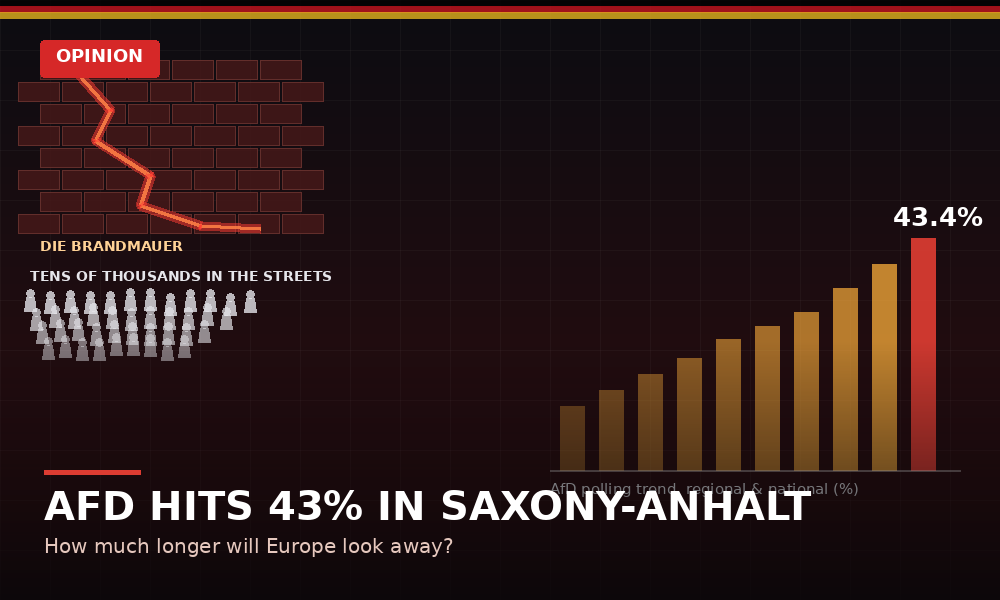
Isn’t it about time voters’ choices at the ballot box were simply made public — that everyone could see who voted for what? I’d say the same should go for identity online. I’m still furious about Germany’s recent state elections, and the protests that followed. What a farce. The AfD (Alternative für Deutschland) keeps growing in the polls: the latest Insa poll puts the party at a record 29.5 percent nationally — almost one in three voters.
Saxon-Anhalt Is a Warning Shot: Far-Right Rhetoric Is Winning
In some states, the echoes of a dark history are ringing uncomfortably loud. In Saxony-Anhalt, the AfD took 43.4 percent of the vote — more than two in five voters. That’s not a fringe result anymore. That’s a warning siren. I’m not claiming every AfD voter is dreaming of a new persecution of Jews, but the party itself openly flirts with the language and symbolism of the 1930s and ’40s. In a country with this history, that should set off every alarm we have. Anyone shrugging off these numbers is underestimating how fast extremism can become normal.
Putin Watches, Europe Hesitates: Who’s Going to Stop This?
Vladimir Putin, I suspect, is watching all this with quiet amusement, while Europe’s current leaders seem to have no idea how to stop this movement. Washington, I’d guess, isn’t exactly unhappy either. Among the crowds marching in Germany’s near-daily protests, plenty are surely there for better working conditions, not for the AfD. But the party is shameless about hijacking that frustration for its own ends. It openly divides citizens into ‘kinds’ — a stance that flatly violates the laws and values of a country that belongs to both the European Union and NATO. Meanwhile, the so-called ‘Brandmauer’ — the pledge by mainstream parties never to work with the AfD — is visibly crumbling in several states.
Is This Proof That Our Democracy Has No Teeth Left?
When will it finally sink in that we, as people and as societies, rarely form any real unity? Over and over we tell ourselves we’re social creatures who look out for one another — but reality keeps proving otherwise. People mostly look out for each other as long as it benefits them; as peoples, we’re far more selfish than we like to admit. At parties we’re all smiles, but you know as well as I do that afterward, in shifting little clusters, the gossip flies — ammunition to be used against someone else later. How many sheep, exactly, are wandering among the wolves?
The Winning Wolves
Be honest: we like to think we can spot the wolves from the other packs every time. Can you? Can you always unmask the fake ones before it’s too late? The gap between winning and losing is razor-thin, and deep down you’d rather stand with the winners — even when you don’t agree with them. The only real question is: would the winners even let you in? As a child, you excluded someone from your group too, didn’t you — over the wrong color trousers, a pair of glasses, or simply a face you didn’t like. I think most of us, again and again, pick whichever side suits us best in the moment. Did you really vote out of conviction this time, or mostly out of fear of ending up on the wrong side?
Vigilance, Not Collective Guilt: What History Actually Teaches Us
History has a familiar pattern: economic insecurity, soaring energy prices, and the feeling of being abandoned are fertile ground for extremist politics — that was true in the 1930s, and it looks to be happening again now, decades later. That explains some of the AfD’s appeal. It is not an excuse, and it is certainly not a law of nature. It’s a political choice — by voters and by parties — and political choices can be reversed. More than a thousand German legal scholars called this summer for a formal procedure to ban the AfD before the Federal Constitutional Court; tens of thousands of Germans have taken to the streets to protest the party’s election wins. That, to me, is reason for hope. Not every German is guilty of what’s happening now — but every European, German or not, carries responsibility not to let this pass in silence. The question isn’t whether history repeats itself exactly. The question is whether we act in time — before we’re left regretting, in hindsight, that we didn’t.