Three strikes, in a single year. In 2026, Google didn’t get one but three serious slaps on the wrist from Europe — and what did the company do? Next to nothing. No apology, no fundamental change of course, just a press release full of legal jargon and a vague promise to “stay in dialogue with the regulator.” I am sick and tired of how easily this company treats fines as a line item, while we, the users, pay the real price every day in the form of manipulation, fraud and deception. Below are the facts, point by point, with sources — no loose claims.
Three Billion-Euro Fines in One Year — And Google Doesn’t Even Blink
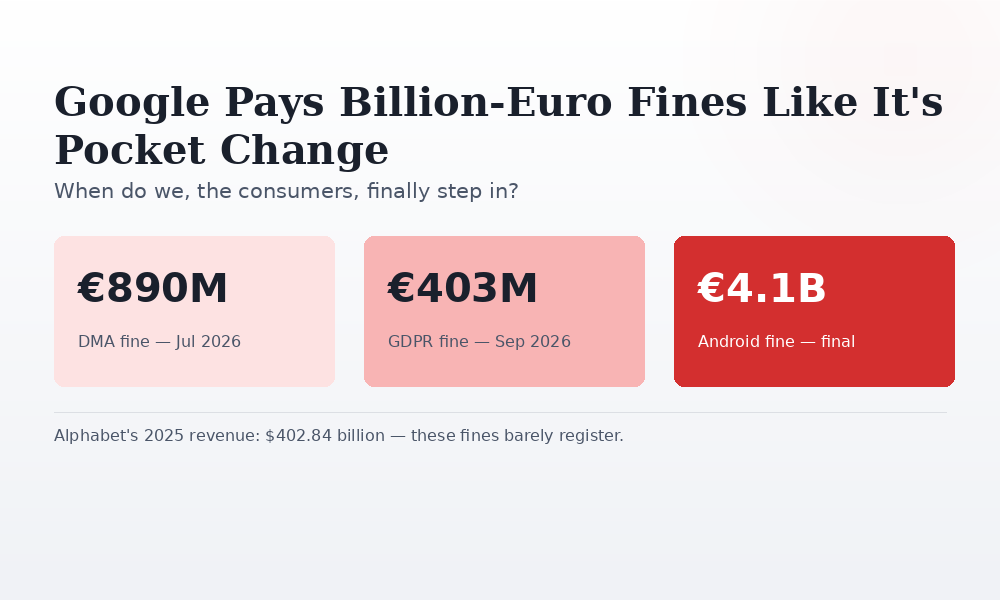
In July 2026, the European Commission fined Google €890 million for breaching the Digital Markets Act: the company had systematically favored its own services in Search and the Play Store, at the expense of competitors and app developers. Less than two months later, in September 2026, Ireland’s Data Protection Commission (DPC) fined Google another €403 million for collecting and retaining location data for years through ‘dark patterns’ — manipulative design choices that kept features like ‘Web & App Activity’ switched on by default. As if that weren’t enough, the European Court that same year finally confirmed the record €4.1 billion fine for Android antitrust abuse, after years of legal resistance from Google. Three billion-euro fines, one year, one company. Do you know what Google’s annual revenue actually is? Parent company Alphabet posted revenue of $402.84 billion in 2025 — roughly €370 billion. An €890 million fine is less than a quarter of one percent of that revenue: the equivalent of a parking ticket for you and me. As long as breaking the rules stays cheaper than following them, nothing will change — and Google knows that perfectly well.
“We’re Just a Conduit” — The Excuse Google Hides Behind While Fraud Runs Wild
Ask any Google lawyer why scammers operate freely on their platform every single day, and the answer is always the same: we’re merely a conduit, a technical platform, not responsible for what third parties post. A nice story — but the reality is far less innocent. The Dutch Consumers’ Association (Consumentenbond) had to take action itself against dozens of dropshippers who used ad platforms like Google to scam unsuspecting consumers with products that never arrived, or that were nothing like advertised. Criminal gangs have actively used Google Ads to con homeowners out of thousands of euros by posing as electricians and other tradespeople. Google itself now sends scam warnings to its own advertisers — an implicit admission that the problem has long since spiraled out of control. So who, exactly, is checking the millions of ads that scroll past our eyes every day? The answer: almost no one, until it’s too late and the damage is already done. Google hides behind the fine print, while consumers are left with empty hands and empty wallets. And yes, there is a legal basis for that disclaimer: Europe’s hosting-liability exemption (once laid down in the e-Commerce Directive, now carried forward in the Digital Services Act), designed for technical intermediaries with no knowledge of what flows through their wires. But Google is no simple internet provider anymore — it trains algorithms on exactly which ad will land with which consumer. A company that knows that much about who we are can hardly hide behind the excuse of not knowing.
Who Decides What You See — And Who Pays For It?
There’s another mechanism that bothers me: through its advertising and search algorithms, Google decides what we see every day, and who we’re allowed to buy from. Doesn’t pay enough, or doesn’t score enough “hits”? Then a business simply disappears from view. Meanwhile, stricter environmental rules and bans on unaddressed mail advertising in more and more countries are making businesses ever more dependent on exactly this kind of digital channel. A system where you have to pay to be seen, controlled by a single party that is simultaneously judge, marketplace and referee. Is that healthy for a free market, or is it a monopoly with a friendly logo? The European Commission clearly thought the answer was worth an €890 million fine. Have you ever bought something and, looking back, couldn’t quite explain why you needed it — only that it followed you around all week through Search, YouTube and a dozen other channels? That’s not a coincidence. That’s the business model. Don’t you find it strange, too, that a single company holds this much power over what hundreds of millions of Europeans see every day — and therefore over what they buy?
Isn’t It Time We, As Consumers, Stopped Just Watching?
I understand that Google creates jobs and provides services many of us rely on daily. But that is not a free pass. Three billion-euro fines in a single year are not an incident — they’re a pattern, confirmed by the European Commission, Ireland’s privacy regulator, and the European Court alike. Fraud on the platform isn’t an unfortunate side effect; it’s the predictable result of a company that offloads responsibility the moment doing so saves it money. The question is no longer whether Google actually suffers from any of this — it barely does. An €890 million fine is a pat on the back, not a correction, for a company pulling in $400 billion a year. The real question is when we, as consumers, as voters, as Europe, stop accepting that a company treats fines as a cost of doing business instead of a signal to change. When do we finally demand regulation that enforces accountability instead of letting companies route around it — and when do we stop shrugging and accepting that ‘we’re just a conduit’ is a valid excuse for one of the most powerful companies on Earth?