For decades, we were told that globalization would connect the world, technology would improve it, and information would help us understand it.
Instead, we entered an era where every force claims to be holding the world together while pulling it in a different direction.
Governments compete for influence. Corporations compete for attention. Algorithms compete for our perception of reality. Entire economies react to headlines within seconds. Every crisis becomes global before anyone has time to understand it.
The world has not fallen apart.
It has become stretched.
We can see the tension everywhere. In politics that grows more polarized each year. In information systems that reward outrage over understanding. In a global economy where a decision made in one country immediately affects lives in another. In technologies advancing faster than societies can adapt to them.
Each force acts independently. Together, they place enormous pressure on the same fragile surface.
The danger is not necessarily collapse.
The danger is distortion.
Because distortion is harder to recognize. It happens gradually. We adapt to it. We normalize it. We convince ourselves that increasing instability is simply the new normal.
What makes this moment unique is that many of these pressures are applied in the name of stability itself.
Nations seek security. Markets seek growth. Platforms seek efficiency. Institutions seek control.
Yet the more aggressively the world is managed, optimized, and reshaped, the more difficult it becomes to recognize the thing being protected.
We are witnessing a paradox of modern civilization:
The more pressure applied to preserve the world, the more distorted it becomes.
Perhaps this is the defining image of our time—not a world at war with itself, but a world being pulled simultaneously in every direction by those convinced they are saving it.
A global stress test with no clear endpoint.
And no agreement on how much tension the system can survive before something finally tears.
The Architecture of Pressure
Pressure is not always visible. Often, it appears through the systems designed to make life more predictable.
We construct institutions to manage uncertainty. We develop technologies to reduce friction. We create economic networks to distribute resources and political structures to establish order. Each system begins with a promise: greater efficiency, greater security, and greater connection.
Yet systems rarely operate independently.
A political decision can destabilize a market. A technological breakthrough can transform employment. An algorithm can influence public opinion, which subsequently influences political decisions. The result is not a single identifiable force but an accumulation of competing pressures.
The modern world resembles a structure whose individual components are being continuously adjusted without anyone fully understanding how those adjustments affect the whole.
This is particularly evident in our relationship with information.
Humanity has never possessed so many instruments for observing itself. We can witness conflicts, disasters, demonstrations, and political decisions almost immediately. We can measure public reactions, track economic movements, and compare events across continents.
But visibility does not necessarily produce understanding.
Information arrives faster than interpretation. Images circulate without context. Complex events are compressed into headlines, emotional reactions, and competing narratives. What should expand our perception can instead narrow it.
The paradox is that the more information becomes available, the more difficult it can become to distinguish the structure of reality from the systems that represent it.
We are connected, but connection does not guarantee coherence.
When Stability Becomes Distortion
Consider the language through which contemporary institutions justify their actions.
Security. Progress. Optimization. Protection. Stability.
These words suggest preservation, yet the actions associated with them frequently involve transformation.
A government strengthens its borders to protect national stability. A corporation restructures its operations to preserve competitiveness. A digital platform modifies its algorithms to improve engagement or safety. Financial institutions intervene to prevent economic instability.
Each intervention may possess its own internal logic.
The difficulty emerges when these logics intersect.
One institution’s attempt to establish stability may introduce instability elsewhere. A solution for one population may create pressure for another. A technological improvement may solve an immediate problem while generating consequences that become visible only years later.
The world is not necessarily being destroyed by these interventions.
It is being continuously reshaped.
This distinction matters because destruction is comparatively easy to recognize. We can identify a collapsed building, a broken object, or a system that has ceased functioning.
Distortion is more ambiguous.
A distorted structure may remain operational. It may continue to perform its intended function while gradually losing the characteristics that originally defined it.
People adapt to these changes because adaptation is one of humanity’s fundamental survival mechanisms.
What was once exceptional becomes routine. What was once alarming becomes familiar. A condition initially described as temporary becomes part of the permanent environment.
We rarely experience this transformation as a single dramatic event.
Instead, we encounter it as a succession of adjustments.
And eventually, we may no longer remember the original shape.
The World as a Material
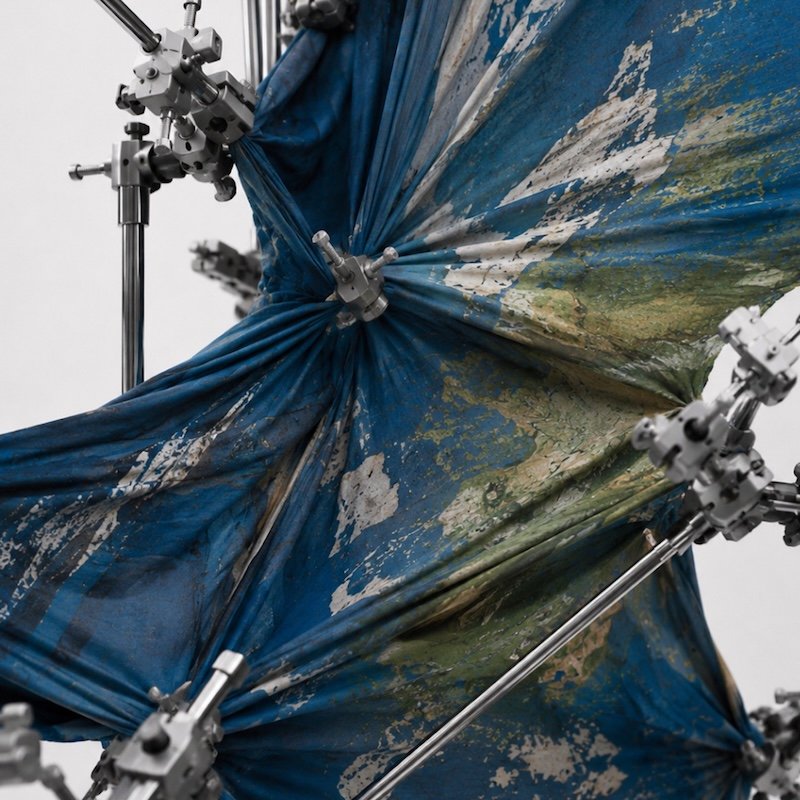
This contradiction became the starting point for my artistic project, World Stress Test.
I wanted to explore what would happen if the pressures shaping contemporary civilization could be translated into physical forces acting upon a recognizable image of the world.
Rather than representing globalization through familiar symbols of networks, borders or technological connectivity, I approached the world map as a material surface.
In the installation, a fabric carrying the image of the world is subjected to tension through a system of mechanical attachments, cables, and a suspended circular structure.
The material is pulled in different directions.
Its surface stretches. Its geography becomes unstable. Familiar continental forms are displaced by the forces acting upon them.
The map remains recognizable, but its proportions no longer obey the conventions through which we usually understand it.
This transformation is central to the work.
A conventional map promises orientation. It offers an apparently stable representation of territory, distance, and spatial relationships.
Yet a map is already an interpretation. It reduces the complexity of a planet into an organized image, selecting particular relationships while excluding others.
By physically deforming that image, the World Stress Test exposes the vulnerability of the representation itself.
The world has not disappeared.
But the instrument through which we recognize it has become unreliable.
The material resists the pressure imposed upon it. Its fibers respond differently across the surface. Tension accumulates around attachment points. Certain areas remain comparatively intact while others stretch or tear.
These differences cannot be entirely reduced to a predetermined image.
The behavior of the material becomes part of the artwork.
The Machinery of Preservation
The mechanical elements of the World Stress Test are not concealed.
The cables, clamps, and supporting structure remain visible.
They are not merely technical devices required to suspend the material. They participate in the meaning of the installation.
Their function is contradictory.
They hold the composition together while simultaneously producing the forces that deform it.
Without them, the material would not occupy the same position. Yet because of them, its surface becomes increasingly unstable.
This contradiction reflects a broader question about contemporary systems of control.
At what point does the infrastructure intended to preserve a structure become responsible for its transformation?
The question does not imply that all forms of intervention are inherently destructive. Societies require institutions, technologies, and mechanisms of coordination.
The issue is the cumulative relationship between interventions.
A single force may appear manageable. Multiple forces operating simultaneously can produce outcomes that none of their individual participants intended.
The installation does not assign a particular cable to a particular country, corporation, or ideology.
Such a literal correspondence would simplify the problem.
Instead, the mechanical structure operates as an image of distributed agency: many points of intervention, each contributing to a condition that cannot be attributed to one actor alone.
No single attachment explains the final deformation.
The image emerges from their combined effect.
The Geography of an Unstable Present
The map of the world is among the most familiar images in modern visual culture.
We encounter it in classrooms, airports, news broadcasts, financial reports, and digital interfaces.
Its familiarity encourages us to treat it as something neutral.
But maps have never been independent of power.
They organize territory, establish boundaries, communicate claims, and shape the way geographical relationships are imagined.
Even the decision to place a particular region at the center of a map can influence the viewer’s perception of the world.
In the World Stress Test, these questions become physical.
Geographical relationships change not because borders have been redrawn, but because the surface carrying them has been subjected to external pressure.
The distortion does not represent a specific geopolitical prediction.
It represents the instability of the framework through which geopolitical reality is perceived.
A continent may remain visible while its shape is altered. A boundary may continue to exist while the distance between its points changes. Familiar geography becomes unfamiliar without disappearing entirely.
This is important because contemporary crises rarely unfold in isolation.
A conflict in one region can affect energy prices elsewhere. A disruption in international trade can influence production across continents. A technological decision made by a relatively small group can alter the informational environment experienced by millions.
Geographical distance no longer guarantees separation from consequences.
The material world remains unevenly distributed, but the systems connecting it transmit pressure across those distances.
The map becomes an image of that transmission.
Its surface records the effects of forces that extend beyond any individual location.
The Viewer Inside the Test
I am interested in the moment when an artwork stops functioning as an illustration of an idea and begins producing an experience of that idea.
A viewer approaching World Stress Test first encounters something recognizable: the world map.
But recognition quickly becomes uncertain.
The familiar image is interrupted by folds, tension, displacement and rupture.
The viewer must mentally reconstruct what is no longer presented in its expected form.
That process is part of the work.
We are accustomed to treating representations of the world as instruments that explain reality to us. Here, the representation itself demands explanation.
The viewer is no longer simply observing an image of global instability.
They are confronting the difficulty of recognizing a world whose structure has been altered.
The installation also refuses the comfort of a completed narrative.
There is no moment at which the tension is resolved, no restored map and no final image of equilibrium.
Instead, the object exists in a condition of suspended consequence.
Its structure appears to hold, but the visible ruptures suggest the limits of that stability.
The work does not provide a measurable threshold at which the entire system would fail.
That uncertainty is intentional.
We can identify pressure. We can observe deformation. We can recognize damage.
What we cannot determine with certainty is how much more the structure can withstand.
A Test Without a Conclusion
The title World Stress Test refers to a familiar procedure: applying pressure to a system in order to understand its limits.
In engineering, finance and technology, stress tests are designed to reveal vulnerabilities before catastrophic failure occurs.
They presume that the system being examined can be subjected to controlled conditions, measured and evaluated.
But what happens when the system is the world itself?
There is no external laboratory. No independent observer who exists completely outside the structure. No universally accepted definition of failure.
The participants conducting the test are also the material being tested.
Governments, institutions, corporations, technological platforms and individuals all participate in processes whose consequences they cannot fully control.
The test continues because the forces generating it continue.
This is why I do not see World Stress Test as an image of an apocalypse.
An apocalypse suggests a decisive event, a recognizable ending.
Distortion suggests something more difficult to confront: a transformation that can continue indefinitely while everyday life proceeds around it.
The surface still holds.
The image still resembles the world.
The mechanisms remain attached.
And the tension remains unresolved.
Perhaps the most unsettling possibility is not that the world will suddenly break, but that it will continue functioning in an increasingly distorted condition.
That we will learn to inhabit the deformation.
That we will eventually mistake it for the natural shape of things.
World Stress Test is an attempt to make that process visible before it becomes completely ordinary.
Not to predict when the world will tear.
But to ask how much distortion we are prepared to accept in the name of keeping it together.