
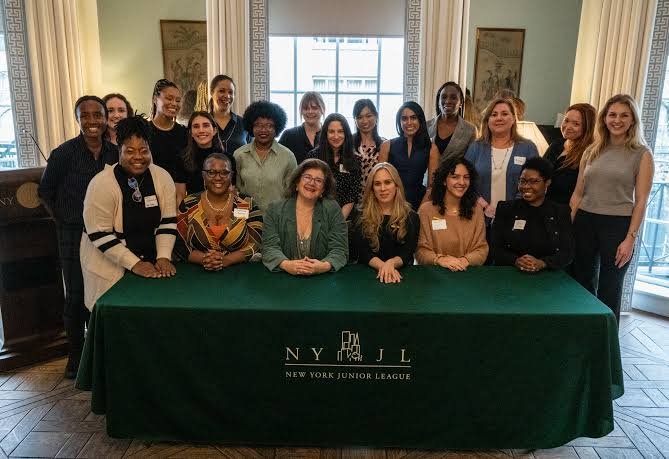


The patriarchy does not need men to survive. It needs institutions that preserve its hierarchies, enforce its expectations, and reward conformity. Sometimes, those institutions are governed entirely by women.
Consider the Junior League, an organization with a peculiar place in the American imagination. The archetypal Junior League woman is wealthy, impeccably dressed, and socially connected. She volunteers for charitable causes, attends elegant fundraisers, and masters the conventions of polite society. She is influential but never disruptive, accomplished but never difficult. Her power depends on preserving the structures that grant it.
In New York City, this image remains particularly potent. Headquartered in a historic Upper East Side mansion, the New York Junior League (NYJL) remains widely perceived as an exclusive social club for affluent women. Yet the contemporary organization seeks to challenge this reputation by emphasizing leadership development, women’s empowerment, and, more recently, diversity.
The League indeed offers meaningful opportunities for civic engagement, professional development, and community building. Its efforts to diversify membership and support historically marginalized women also represent important progress. But diversity does not guarantee equity, nor does women’s empowerment necessarily challenge patriarchy. An organization can welcome marginalized women without allowing them to transform it. This is the fundamental limitation of empowerment divorced from feminism.
Empowerment promises women opportunities to succeed, lead, and exercise influence, but it does not necessarily question the systems through which success and influence are distributed. Feminism, however, requires us to ask uncomfortable questions: Who holds power? How did they acquire it? Whose interests does that power serve? Which women are excluded? And what would it take to redistribute that power?
Patriarchy is not simply a system in which men exercise authority over women. It is sustained through hierarchies of class, race, sexuality, respectability, and social status. Women can participate in these arrangements, benefit from them, and reproduce them, even within organizations devoted to women’s advancement.
Notably, the Junior League does not formally identify as a feminist organization. Its mission emphasizes women’s leadership and community impact while expertly avoiding an explicit commitment to feminist ideals. This is not a contradiction in its stated identity, but it reveals the limitations of its ambitions.
I spent over four years in NYJL leadership roles spanning diversity, equity, member engagement, and governance, witnessing meaningful progress toward inclusion. In 2023, I founded its LGBTQIA+ & Allies Affinity Group, the first Board-approved queer affinity group in the Association of Junior Leagues International. It created space for queer members within an institution historically centered on heterosexual marriage, motherhood, and conventional femininity.
But the Affinity Group existed as a counterpublic within a dominant culture still anchored in conventional womanhood. Provisional graduates dress entirely in white, evoking debutante traditions. The League’s Park Avenue townhouse has an unspoken dress code; one member recently dubbed a $278 Hill House dress its “unofficial uniform” on TikTok. Each Christmas, the Astor House is elaborately decorated, and committees auction handmade wreaths at Golden Tree—the League’s Christmas-centric holiday shopping fundraiser. Meanwhile, the Mothers’ Affinity Group hosts an annual Easter egg hunt, and Femme Finance offers programming centered on marriage and family planning.
None of these traditions is inherently objectionable, but together they reinforce a narrow ideal of belonging. For women outside the League’s historically wealthy, white, Christian, heterosexual, cisgender, and conventionally feminine norms, inclusion can resemble an invitation to assimilate.
As a queer woman, I experienced this firsthand. The LGBTQIA+ & Allies Affinity Group was celebrated as evidence of the League’s inclusivity, marching in Pride and increasing queer visibility. Yet board members questioned our efforts to recruit lesbians, and we were discouraged from distributing affinity group materials at member socials because they were deemed “political.”
Once, I was personally approached and told that I needed to “tone down” my queer identity if I wanted to succeed in the League. Another time, a fellow member admitted that she could not understand how a childfree-by-choice woman like me could even be aligned with the League’s mission. I reported these incidents through the leadership channels available to me, but rather than receiving clarity about an investigation or disciplinary process, I was encouraged to consider whether I had misunderstood the encounter and extend grace to the offending member. Of course, I cannot know everything that occurred behind the scenes, but what I do know is that I received no substantive explanation of if or how my complaint had been addressed.
Feminist scholar Sara Ahmed describes how institutional commitments to diversity can become “non-performatives”: declarations that do not necessarily produce the changes they announce. Institutions can point to their commitments as evidence of progress while leaving the underlying arrangements of power substantially unchanged. At the NYJL, these arrangements were reinforced not only through tradition but also through institutional governance.
For example, serving on the NYJL’s board requires both leadership experience and a specified financial contribution. One might argue that this is how non-profits are traditionally structured, but for an organization devoted specifically to developing women’s leadership, this raises an uncomfortable question: Why should access to its highest governing body carry a financial obligation? Even when applied uniformly, this requirement disadvantages equally qualified women without disposable income, making financial privilege a condition of institutional power.
Money is not the only currency of influence. Social connections, proximity to leadership, and familiarity with elite philanthropy also determine whose voices carry weight. In my experience, those who navigated existing hierarchies wielded more influence than those who challenged them. These hierarchies persisted not only through executive leadership but through the everyday practices of members.
In fall 2026, two new leaders of the LGBTQIA+ & Allies Affinity Group proposed a collaborative workshop with the League’s Social Equity Committee. As their mentor, I understood the initiative as an opportunity for them to develop leadership skills. They were inexperienced, certainly, but that was precisely the point of a leadership-development organization: to help women become capable leaders through meaningful participation.
Instead, substantive planning decisions were made without them. The President and Executive Vice President became involved in discussions with Social Equity leadership, an external speaker was selected, and an executive directive was issued to include the Women of Color and Mothers’ Affinity Groups. But neither the original organizers nor the additional affinity groups had been meaningfully consulted about these decisions. When I questioned the process, I was repeatedly reminded of executive directives and committee authority. What’s more, the LGBTQIA+ leaders’ inexperience was cited as justification for proceeding without them, despite my earlier requests for additional mentorship and support.
The irony was difficult to ignore. A workshop intended to celebrate diversity had become an exercise in institutional hierarchy. The League could showcase marginalized affinity groups as evidence of inclusion without allowing them to shape the initiative. This is tokenism in practice: celebrating marginalized identities while denying their voices meaningful influence.
Equally troubling was members’ deference to executive authority, even when it undermined the League’s commitment to leadership development. An “executive directive” seemingly outweighed opportunities for collaboration, mentorship, and meaningful participation. This is how patriarchal power reproduces itself: through those who normalize deference, enforce hierarchies, and treat challenges to authority as disruptions rather than opportunities for change.
And this is precisely why intersectional feminism matters. Feminism is not merely a commitment to helping individual women advance within existing institutions. It is a critical framework for examining how those institutions distribute power, reproduce inequality, and determine whose experiences matter. It asks not simply whether women can lead, but whether the structures in which they lead deserve to remain unchanged.
The New York Junior League has accomplished meaningful work, and many of its members genuinely strive to build a more inclusive organization. But feminist transformation requires more than diversifying membership, celebrating marginalized identities, or offering women opportunities to lead. It requires a willingness to reconsider the traditions, relationships, and structures through which institutional authority is maintained.
Women’s empowerment asks whether women have a seat at the table. Feminism asks who owns the table, who paid for it, who decides where everyone sits, and why some women are still expected to serve. Until the Junior League is willing to confront those questions, it may succeed in developing women as leaders but will leave the patriarchy remarkably undisturbed.