
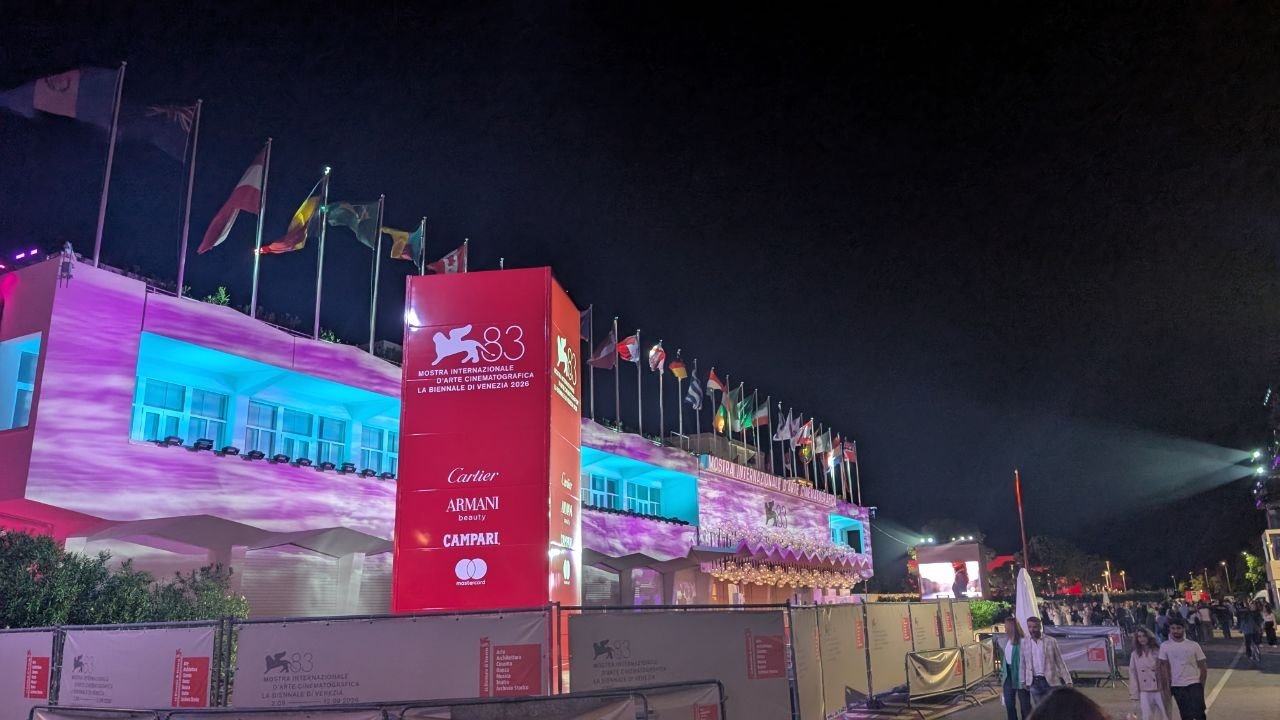


Day 1—Pens are ready to write!
2 September was, for many, a bitter sign that summer had actually ended, though not in Venice. In Venice, it had only just begun. Aperols and espressos had been tasted—now it was time for the cinema. Alberto Barbera’s smile shone all over Venice, and under its rays, festival visitors were welcomed as warmly as nowhere else.
The opening film of this year’s festival was Ink (Danny Boyle, 2026) – a pounding approach to the printing press that resulted in an ink-carved demonstration of the influence of the establishment and the media, an ethical debate over the permissibility of yielding to the will of the majority, and, on a larger scale, a stripping away of the meaning behind the question “why?”. The best choice for the opening film of any major film festival this year – one that will hopefully be mentioned later this year, and not just once. Jack O’Connell and his team try to figure out what sells to the public; meanwhile, Danny Boyle makes a film that actually sells! A film about the rise of the newspaper The Sun only promises us that, for the next 11 days, we will be basking in the sun!
Danny Boyle and his wonderful cast (Jack O’Connell, Guy Pearce, and Claire Foy), accompanied by the one and only George Clooney, who received the Golden Lion for Lifetime Achievement at the festival, were shining on the red carpet. Thus was the festival opened!
Day 2 – Hild Worses
The second day of the festival was big on names. Herzog and McDonagh premiering on the same day is something any cineast would crave to see.
Bucking Fatsard (Werner Herzog, 2026) begins with a dedication to the great David Lynch, which explains the shift in the aesthetics of his language. Herzog continues to explore the utmost weird peculiarities of the human mind. This time, under his microscope fall the Chaplin sisters, whose names were altered for the film. The Holbrooke sisters (their names in the film) do and say everything simultaneously, even fall in love with the same person, which is the starting point of the Möbius strip of the story, playing out much more adorably than violently. Unexpectedly, especially for the biggest opponent of psychoanalysis, Herzog embraces psychoanalytic elements, trying to find a way out of the cave of imagination, dreams, and inspiration, which can be exhausting for both the characters and the viewers. The Mara sisters deliver the performances of their careers, while Herzog is obviously getting old, though he tries to prove that age is not the problem.
McDonagh, on the other hand, proved once again why he is probably the greatest playwright of our time. Wild Horse Nine (Martin McDonagh, 2026) is a tragically hilarious depiction of CIA agents, played by John Malkovich and Sam Rockwell. John’s character is suffering from dementia and cancer and is willing to end his life on Easter Island, causing a few problems for the CIA by being a tiny bit too talkative. A strong tragicomedy delivers an important commentary on the modern world and the ways of political functioning within it, while remaining completely humane.
Orizzonti, the festival’s side program, showed a peculiar film, Too Much Sugar (Robert Greene, 2026) – a quasi-documentary about a father and his family who are trying to make films about their lives. “Too much” is the best way to describe it – too much meta, too long, simply too much, and almost exhausting in its repetitiveness, though very charming. The mention of Terrifier 3 in the film puts it into perspective: the first part is enough; the second is acceptable but redundant, and the third is completely unnecessary.
Day 3 – A Place to Kill
The extreme heat in Venice only heightened the anticipation for the new Shinya Tsukamoto film, Mr. Nelson, Did You Kill People? (Shinya Tsukamoto, 2026). But before witnessing the latest work by a Japanese master, Cédric Kahn premiered in the Concorso (competition) with his film A Place to Heal (Cédric Kahn, 2026), about young people between the ages of 15 and 18 who have psychological problems and are placed in a sort of hospital. A solid French social drama, the kind one would expect to see in Cannes, changes direction during the last 30 minutes, turning an almost unbearably boring experience into something quite interesting. Cédric Kahn’s directing is not phenomenal, but rather simply good in its steady yet sterile approach to this story about rebellious and troubled teenagers unable to control themselves. And if films like this aren’t shown in competition, then they aren’t shown at all.
American soldier in Vietnam reliving his traumas through psychotherapy sounded promising. Tsukamoto achieves his goal of putting the viewer in the place of the perpetrator, which is extremely humanistic but, at the same time, questionable. The red carpet had the smell of the bloody path Nelson went through, especially with the deafening soundtrack accompanying it. The main question for Tsukamoto, though, is not whether Mr. Nelson killed someone, but why he did it. The question of why, the meaning of which was redacted by O’Connell’s character in Ink, is at the center of the search for the core. Mr. Nelson’s psychotherapist (Geoffrey Rush) takes an existentialist approach to PTSD, which proves successful, though answering the question is not enough – Tsukamoto pinpoints the integrity of existentialist psychoanalysis in its translation of reason into purpose. Masterclass directing, though, does not leave the strongest impression.
Venice Open showed an interesting film, Queer Edward II (Theo Rollason), about Derek Jarman creating Edward II (Derek Jarman, 1991) and the political activism behind it. The most interesting part was the opening of the film, which stylistically reminded me of Moonage Daydream (Brett Morgen, 2022), the documentary about David Bowie. Had the film stayed in the same aesthetic mode instead of switching to a banal documentary about a queer creator oppressed by harsh times, it might have been great. But as a Derek Jarman fan, I was quite satisfied with this introduction to the mind of a genius who gets much less acclaim than he deserves.
Also shown out of competition was Takashi Miike’s new film, and unfortunately, it was not Bad Lieutenant: Tokyo (Takashi Miike, 2026), which premiered in Toronto, but rather a documentary about Kabuki theatre, which may be of some interest to Japanologists or die-hard fans of Miike.
Everyone was getting used to the taste of terrible coffee and the most enjoyable Aperol; the sun was shining not only in Danny Boyle’s film; the red carpet was being prepared for the main event; the late-night vaporetto sounds were reminiscent of the snoring of those falling asleep during the films – which meant that the third day of the festival was over.
Day 4 – It’s Primetime, Folks
The most awaited, the most impossible to get tickets for, the one shining brightest on the red carpet – the film that Barbera somehow managed to get into the line-up – Primetime (Lance Oppenheim, 2026). The trailer got more than 40 million views on YouTube; the film went viral the second it was announced as part of the festival; memes with Pattinson were, and still are, flowing, and it seems there is no end to them. And what a pleasure it is to say that all the attention the film has received is well deserved – Lance Oppenheim is probably the most promising director in the US today, bringing the aesthetic precision of his documentary work to his fiction debut with extreme delicacy. The criticism of the A24 style of the movie is completely irrelevant – it is not an A24 film, but a Lance Oppenheim film, and Barbera must have felt it immediately. Robert Pattinson delivers the best performance of his career – and since he is the producer of the film, I must say, we should start recognizing the genius behind this man, which seems to lie not only in his artistic talents.
Primetime tells the story of Chris Hansen, who is famous for creating the show To Catch a Predator, which sparked many debates. However, both Lance Oppenheim and Robert Pattinson made it clear that criticizing the TV show or Chris Hansen himself was never their objective in the first place. It was more of a starting point, and the film goes much deeper than it may seem, with the ultimate victim of it (if one can call it that) being the public.
Primetime reconstructs the audience of its own time and of ours, presenting the fetishistic fascination with form as the main symptom of our time. While the substance is being defended, everyone forgets that the main problem lies not in “why” but in “how.” In the end, an obvious utilitarian problem may arise: whether the achievement of a goal is worth the price of sacrifice. Though the stakes are not that obvious, a second question is raised, a rather more difficult one, even if it is smaller in scale – was it really the public’s demand for Chris Hansen that made his show so popular, or was it precisely that moment in history when suppliers started determining the objects of demand? And even if Lance Oppenheim doesn’t directly engage with these questions, preferring instead to reconstruct mythological lines through Hansen, they still seem to be important to the film’s underground structure. Bold, but great!
Putting Nanni Moretti’s It Will Happen Tonight (2026) just after Primetime was the best decision Barbera could have made – nothing tastes better after a full-force punch to the head than the hair-caressing touch of the kindest living Italian magician. It Will Happen Tonight, starring another sex symbol, Louis Garrel, tells a rather daft story about Matteo: the warmest hug under the rainbow, from which the stones are rolling towards the brightness. An unbelievably optimistic and heartwarming film is exactly what every festival competition needs, especially from such a maestro as Moretti. Overflowing with nice moments, such as a dance sequence to a Rolling Stones song, a father and son attending a Bruce Springsteen concert, or a priest making a nice gesture, the mosaic-like colorfulness of the film does not lead to a great and fulfilling story at all but definitely sweetens the rest of the day.
At night, though, the unmissable reunion of the Gallagher brothers took place at the premiere of the documentary about them, creating the funniest story of the whole festival – when addressing festival artistic director Alberto Barbera, they called him George Clooney, who must have been sipping a Negroni by the Adriatic Sea.
Day 5 – Lion and Grand Prix on the Same Day
Though I am planning to touch on the awards at the end, it is impossible not to mention that both the Golden Lion and the Grand Prix premiered on the same day. However, their premieres were separated by Italian director Andrea Pallaoro, who presented The Echo Chamber (2026), starring Luca Marinelli, Alicia Vikander, and Susan Sarandon. It would not be an exaggeration to describe this film as the dullest in the competition. The film was highly anticipated because its script was written by Bernardo Bertolucci. Ironically, the selling point of the film is also its main problem – Pallaoro manages to make a drama shot entirely in one room cinematic enough; however, the sheer stupidity of what is happening on screen and the depiction of all the possible banalities bring this two-hour-long machine about a self-destructive and self-pitying man to an end, a machine with only one purpose: to completely bore its viewer. The downward spiral and rise of the junkie music producer has just one episode that makes you pleased, and it is seeing him being punished in the most ridiculous way – a car accident with Imagine Dragons playing in the background. Drugs are bad, art is good, love is destructive and rescuing – put all this in a single flat and you get what you expect: dissatisfaction. You can only pray that the characters also won’t be able to get satisfaction under any circumstances – but Alicia Vikander’s character having an orgasm with a paralyzed man is probably the most face-palming thing Bertolucci could have written. Andrea Pallaoro made, undeniably, the worst film of the competition, and just as his character deliberately broke his arm in the pursuit of God knows what.
Woman Unknown (May el-Toukhy, 2026) was the only film directed solely by a woman in the competition. A strong drama about a woman afraid that her secret will be revealed, while a greater oppression of women is taking place on the streets of Copenhagen. World War II has just ended; horizontal collaborators are being dragged into the streets, where they are stripped, shaved, and thrown into the mud, with red swastikas painted on their breasts. Post-war brutalities frighten Marie (Mathilde Arcel), who herself is hiding an affair with a German man from her past that may destroy her current life. An intriguing, or rather disturbing, depiction of historical injustice imprinted on the life of an unknown woman.
But the main event of the day was the return of Korean master Lee Chang-dong, whose last film came out eight years ago. And it can be said with certainty that the wait was worth it. The most intelligent film of the year – if last year the film everyone called monumental was One Battle After Another (Paul Thomas Anderson, 2025), and two years ago it was The Brutalist (Brady Corbet, 2024), then this year it is not DAU (Ilya Khrzhanovsky, 2026), but Possible Love (Lee Chang-dong, 2026). There is no other Lee Chang-dong!
Possible Love is nominally a remake of the tenth chapter of Kieslowski’s Dekalog (1988-1989). The film begins by quoting the tenth commandment: “Thou shalt not covet”. After that, it takes the most poetic approach to such a novelistic problem. A lyrical touch from the great philosopher, bringing his cinematic methodology to the surface in order to write a novel about the dysfunctionality of the modern world. No matter how hard you whistle, the deaf will not hear, which is why Lee’s soft touch hits so hard. It is, most probably, the greatest piece of cinema of the year. If there is one auteur whom we should consider the most intelligent in modern cinema, then Lee Chang-dong is the one.
Day 6 – Look, It Is the Spiral
The magic of an enormous humanist is unfortunately lost – Hirokazu Kore-eda tries to write an anime with his camera in his second film of the year, Look Back (2026). Largely anticipated not so much because of the director, but because of its source material, Look Back is based on the eponymous manga by Tatsuki Fujimoto, which has gained quite a fanbase. Kore-eda tries his best to make at least something out of a dull and manipulative story about two girls bonding in pursuit of the same goal, whose paths diverge, but his pen seems to be empty of ink. Beautiful Japanese landscapes, mixed with the most basic story, are enough for a viewer to burst into tears, while Kore-eda seems to have finally lost his finest image-building. And even if some landscapes can remind one of Bruegel, the fakeness behind the coming-of-age story is most apparent in the clear metaphor of growing up – the swans that fly through the landscape were clearly animated. The characters stay just as infantile as they were, preferring escapism to direct confrontation with reality and seeing art as the perfect medium for that – something you don’t expect from the director of Shoplifters (2018). Disappointing, though cute.
But what one could not really expect at the festival was to witness a pure genre film in the competition. The Italian The Spiral (Paolo Strippoli, 2026) is the nicest surprise from Barbera. Without spoiling the adventurous story that Strippoli created with Salvatore De Chirico, I will just mention that it is about a misfortunate family who are faced with several deals with the devil. A surprisingly engaging and absolutely hilarious film divided people in Venice, where some could not understand why it was in competition, while others were simply enjoying this pure hidden gem.
Let’s not forget Orizzonti, which manages to introduce some new names to cinema. The Thai film Burning Giants (Phuttiphong Aroonpheng, 2026) is one of the most interesting discoveries of the festival. Reflective, slow, magical – everything we like about Thai cinema, packed into the burning voice of a new auteur. Aroonpheng is still searching for his own style and is heavily inspired by Apichatpong Weerasethakul and Tsai Ming-Liang, but this is quite an achievement for a third feature film. The potential is there; let’s hope the execution does not let us down.
The biggest event of the day, though, was the premiere of the third film in Sophie Fiennes’ Žižek trilogy. The Pervert’s Guide to Utopias (Sophie Fiennes, 2026) is a pessimistic hard knock on the door of ignorance. The door built out of movies is being broken down by the very tools it is made of, and Žižek is responsible for those first cracks in the door. So, let’s hear him out – because, anyway, the film is about the end of the world.
One of the most interesting things at the festival is a long wooden board, which serves as a place for free commentary. It may be a funny joke, a critique of how terrible the toilets are, or a complaint about how long the lines for an espresso are; it may be anything at all. One of the quotes was: “Arrested Memory is my mental state after six days at the festival.” The unexpected appearance of SABU in the line-up with an action film about a police chief who has problems with his memory was one of the most pleasant ninety minutes at the festival. SABU manages to possess the viewer ridiculously throughout the whole picture, intensifying its plot, and even though the fight scenes are not all that mind-blowing, it is a nice shake-up at the festival. How unfortunate that Barbera lost Bad Lieutenant: Tokyo (Takashi Miike, 2026) to TIFF, because I would not mind having watched another action movie on the Lido. Closing the day, SABU sent us off to a good night’s sleep in preparation for the stardom of the following day.
Day 7 – You Don’t Want This Company with You in the Bunker
The seventh day prepared the most hyped duplet of the festival: Bunker (Florian Zeller, 2026), with Javier Bardem, Penélope Cruz, Steven Graham, and Paul Dano, and Company (Casey Affleck, 2026), who keeps the nepo-tradition alive.
Company is probably one of the most boring films, not just in the competition, but at the whole festival. Story inside a story inside a story – ninety minutes of people telling stories and keeping the worst company with each other and with the viewer. At some point, a character tells a story, and you feel it is relevant (absolutely not), but you cannot remember what he just said because it was the fiftieth boring-to-the-grave story told in such a monotonous way that you cannot help but fall asleep. Casey Affleck managed to give his children, who are quite talented, roles that may single-handedly ruin their whole careers. He sucked the blood out of every viewer like a vampire, making everyone ninety minutes older. The plot twist, which is supposedly meant to be shocking, leaves only a bitter aftertaste of the lost opportunity to have an Aperol at the beach instead of paying any attention to Casey Affleck’s nepo-project aimed at securing his family’s position in the film industry, as if it needed any help.
The same could be said about Florian Zeller, who definitely treats his viewers like children who need every small detail explained. If McDonagh is a great playwright, Zeller is a failed one, but still a pleasant one to keep around. Bunker touches on the theme of class division and several other problems, presenting them as caricaturally as possible. But the tandem of Bardem and Cruz, together with some nice actors in the supporting roles, one successful metaphor, and great production design, save the story, which desperately needed rescuing – or rather, throwing in the garbage. What on paper was a potentially great film turned out to be a pleasant but thoughtless leftist commentary on the way our world is, ending with the most banal phrase imaginable.
Well, at least Tsai Ming-Liang didn’t disappoint with his eleventh film, Dust (2026), in the Walker series. Lee Kang-sheng, as the walker, reaches San Sebastián, where Tsai Ming-Liang had later arrived for a festival. Another Buddhist meditation was worth it, at least for the cute photo of Barbera and Tsai.
DAU 8 – The Fire Within Corporate World
The festival was slowly coming to an end, but the great films were not. Besides three premieres from the Concorso, two films by European directors were of particularly high value. Kornél Mundruczó made his third American film, Place to Be (2026). Written by his wife, Kata Wéber, and featuring some of Hollywood’s stars, it was hard to miss, especially with the ninety-three-year-old legend Ellen Burstyn playing the lead role. She and a much younger companion of hers, played by Taika Waititi, are trying to return a pigeon that has left its owner, and in the process begin to platonically embrace each other. An unexpectedly sentimental film from Mundruczó hits you right in the heart, tears you apart, but in the nicest way possible, and leaves you with a little sweet kiss on the forehead. The heights Ellen Burstyn reaches at her age are unbelievable, Taika Waititi reminds us what a nice guy he is, and Mundruczó shows us that his empathy does not necessarily have to take a brutal form.
The other film, shown in the Venezia Spotlight section, is the Georgian Guria (Levan Koguashvili, 2026). Guria is a region in Georgia, but as the film’s director states, within the geography of the film, it is much more than that: it is “a state of mind.” A poetry of active switching between the poverty of the land and the richness of the mind – this thin line between them, which is almost as invisible as the magical healing powers of the black sand at the beach. Darkly ironic and harshly hilarious, Guria takes time out of a person, surgically purifying human material from problematic times, just as a doctor in the film extracts pellets from an arm.
And again, two out of the three films shown in the competition that day went on to receive prizes. Describing The Fire Within You (Edoardo de Angelis, 2026) is just as unnecessary as the panic attacks Italians were having from laughing at the screening. Two other films, though, are worth discussing.
Monstrous, monumental, great, gigantic, unprecedented – it does not matter how you describe Ilya Khrzhanovsky’s art project; the scandals that arose around the ethics of the film are unmissable. But what this premiere meant was that a twenty-year-long project was finally over. And its result is very questionable. The main question for me is: is it really something unprecedented? And even if it is, was there really no other way to recreate totalitarian violence? Does art really need to exert such dominant power over the actors to evoke actual fear in them? Could the “brutalist Oppenheimer” not have been made with a different approach?
DAU (2026) was, from the beginning, a project about the Soviet physicist Landau, but it grew over time and became an aesthetic social experiment about the mechanics of totalitarianism in the USSR and in general. Though the form and method Khrzhanovsky chose were quite extravagant, he needed every detail, every design piece, every dress, and every book to be from the time in which they were filming. More than that, people had to live at the institute built specifically for the film. The total budget of the project is not publicly accessible; however, Khrzhanovsky declares that there is no other art project with such a budget. So, the goal of the project was to figure out those totalitarian methods by using the same totalitarian methodology – the circularity is obvious, the statement unclear or even non-existent, the form striking but also frightening, and though the film has clear merits, the project is rather unsuccessful, besides all the scandals circulating around it for more than a fifth of a century.
Stéphane Brizé, on the other hand, deals with the deconstruction of the modern corporate world much more delicately in his A Good Little Soldier (2026). The film dives into the corporate world through an HR (human resources) worker. Brizé does not depict evil corporations through openly toxic and inadequate workplaces – evil is hidden under the image of a nice boss who will laugh at your joke about carbonara, but behind this smile will be firing workers who underperform because of a toxic manager. And evil is also inspiring – just as the boss talks to his workers, Carla, brilliantly played by Alba Rohrwacher, talks to her son. Brizé goes into the world of corporate violence, unapologetically undresses it, and shows its hidden map without any fear of making new errors.
Day 9 – We Are on the Ground Floor
The ninth day was very representative – even though one of the main films premiered that day, the overall mood of the festival felt lost. As usual towards the end of the festival, many American journalists had left the wonderful island of Lido for Toronto, where some other films outside the Venice programme premiered. But Barbera did everything to make that day interesting – the premiere of NAZA (Yuval Abraham and Rachel Szor, 2026) and the premiere of the AI film Be Brave (Francesco Carrozzini, 2026) in Sala Grande were quite provocative moves.
NAZA is more of a journalist’s statement than a film that should be presented in Competition. In any case, the reasons for making it as a film are valid – the film will reach a much bigger audience than another journalist’s article, especially when it is made by Oscar winners and will most probably be nominated for the second time. NAZA is an important journalistic statement, rightfully breaking an applause record at Venice, and it is perhaps the only activist documentary at the festival that can actually change something – it is factual propaganda for the elections in Israel, but the kind that is necessarily needed.
But the film that the competition did not need was Un Peu Avant Minuit (Nicolas Pariser, 2026). Sad Melvil Poupaud walks through the streets of Paris, talking to his politically active daughter and some friends from his past. The magnificent streets of Paris are disturbed by boring dialogues. Fans of Nicolas Pariser, if such people exist, will most definitely like it; as for everyone else – hard pass.
At least the day ended on a good note with a wonderful film by Orizzonti winner Gábor Reisz, who was quite shockingly moved to the section below. Premiering in Venezia Spotlight, Reisz deserved a place, if not in the Concorso, then at least alongside the other big names in Venezia Open. Unfortunately, Ground Floor (2026) may get much less attention than it deserves.
Kristóf (Ádám Tompa) comes home and finds out that the wall behind the wardrobe is completely covered in black mould. That is the whole premise of the movie, which hilariously takes all the dirty clothes out of society’s wardrobe – the house in total disarray enters your life even if you try to detach yourself from its problems, and unpleasant neighbours will catch up with you and drag you down with them. Dark irony and an acceptance of complete hopelessness are what make it so hilarious to watch, even though the light at the end of the tunnel is just as dim as the light before sunrise. But as the moulding of the house is inevitable, so is the sunrise. A slightly grotesque demonstration of social relations in a house that slowly destroys itself – how ironic.
Day 10 – Ritorno a Lido di Venezia
However unfortunate it may be, the festival is at an end. Two films that sounded like probable favourites for the awards both disappointed. The awaited return of Marco Bechis after more than ten years was strong and important, though problematic. Ritorno a Buenos Aires (2026) tells the story about a victim and survivor of torture under the dictatorship in Argentina who returns to Buenos Aires to testify against the soldiers responsible for the torture and deaths of people in Garage Olimpo. Flashback plays a huge role in the film – it is not just a cinematic method, but a psychological trauma of Mariano (Adriano Giannini), who feels the guilt of collaborationism. The only and main problem of the film lies, unfortunately, in its most important part – the flashbacks are aesthetically severely different from the rest of the film, as if they had been visually Netflixised. Besides that, the film has a few powerful scenes, showing that Bechis is not finished with the trauma of his life and still has some juice left in his legs. Trauma is an imprisonment for life – quite a pessimistic end to the festival.
But before the pessimistic ending, we had a moment of sleepy hope – A Bit of Light (2026) by Iranian director Ali Asgari was a bit shameless towards his Iranian coworkers. A film about a doctor who helped the protesters and whose medical practice was shut down because of that, and who considers suicide but reconsiders after spending a day with his family, is just as inspirational as it is tranquillizing. Long story short, even though the film is just an hour and a half long, there are nice things in life, so despite the political despair on the streets and possible repression in the following days, it is still worth living. Asgari’s wise silence is much less preferable to seeing him cutely dancing with his team at the premiere.
Day 11 – God is a Woman, and she laughs
The last day of the festival, the day when the fates are decided – who will take the Golden Lion, who was right, and whose fears are coming true? The Lido is emptier than ever, Campari counts the overall number of Aperols people have ordered, empty wine bottles are overflowing the trash bins, the last paninis are being swallowed, and everyone is waiting for the main event of the day – the closing ceremony.
Malou Khebizi received the Marcello Mastroianni Award (Best Young Actor/Actress Award). Since the competition did not include many films with young actors, this was a nice choice – Malou’s performance is powerful and memorable, Cédric Kahn knows quite well how to work with actors, and he approached his material with great delicacy.
As I began with actors, it would only be right to continue with them. The Coppa Volpi for Best Actor went to the genius John Malkovich for Wild Horse Nine. Already a cult actor, he is definitely going for all the awards this year – it is the role of his lifetime, in which he shows what a great gift he has. And even though this year may be Pattinson’s year, Malkovich has maturity to offer instead. Times of youth will come; let’s honour the Man himself – it must be a real pleasure to be John Malkovich.
Mathilde Arcel received the Coppa Volpi for Best Actress, thus marking the first award of the evening for Woman Unknown. The most scandalous decision of the jury, in my opinion, is not, as many may consider it, NAZAnot receiving the Golden Lion, but rather the breaking of an unspoken rule: one film – one award. Mathilde Arcel’s performance was undeniably good. Her acting breakthrough must be seen by European producers; however, a greater success of the film may spoil it.
The Best Screenplay award went to Stéphane Brizé, Coralie Amédéo, and Olivier Gorce for Un Bon Petit Soldat. The meticulously constructed screenplay strikes with its harshly ironic lines, while still making the film engaging on every level, without undermining the intelligence of the viewer. A very well-deserved award.
What scared many, while others wished for it, did not happen – NAZA did not get the Golden Lion, as had been rumored on Lido. Only the Special Jury Prize was granted by the Jury to the film. The scandal of the previous year did not happen, even though Jury was in the same position – leaving the film without any award is impossible, while granting it the biggest one is not desirable. And even though Kaunter Ben Hanya, the director of The Voice of Hind Rajab (2025)and winner of the Silver Lion previous year, was part of the jury, it did not help the film achieve a higher award.
The Silver Lion for Best Director went, quite predictably, to Ilya Khrzhanovsky for DAU. It seems that any film with a monumental or striving-for-greatness intonation is going for the Best Director Award, even if that means that the director ignored any social or ethical norms while filming his “masterpiece”. Well, as said earlier, the only thing that this award means is that DAU is finally over.
A very interesting and saddening decision of the Jury was to award Possible Love with the Grand Jury Prize. Just as happy as it made me after hearing that NAZA achieved only the Special Jury Prize (which induced everyone to think that the Golden Lion would go to Lee Chang-dong), the same way it was disappointing to find out that the best film of the festival, if not of the year, was not properly perceived. Fortunately, Lee Chang-dong is the director who does not need any award to forever be remembered as a great thinker and magnificent director.
The Golden Lion was awarded to May el-Toukhy – the second award for Woman Unknown.The Danish director triumphantly got the Lion as the only female director in the competition. And even though I would like to believe that Jury did not award the film solely for that reason, I cannot think of any other. A quiet standard, though strong, European drama in a competition where several films were much better received the main award – a decision that probably stunned everyone. I cannot believe in the lack of prejudice in this case – a much more logical statement would have been awarding the film with the prize for best directing. Disappointing results of a not-so-disappointing festival.
A mythological city creating a mythological festival that, despite journalists talking about its downfall, will stand tall for as long as it exists. Barbera collected a very nice selection of cinematic wonders, presented a few actual masterpieces, let some new voices through, made some bold statements – in brief, showed that he still has it! Scandalous, but very welcoming, smiling with pure kindness, Alberto Barbera is a great fighter who won’t go down. No matter how big the scandals become, it will be unbelievable for the Biennale committee to take him down. The festival selection of this year may be compared to a good Aperol Spritz – right sweet and right bitter; a little bite of the orange slice sweetens a bitter way home, while tears are sliding down the face because the ice has melted, the last vaporetto has been taken, and now it is another year of waiting… Ciao, Lido di Venezia, see you next year!