Original Artworks by Deep Digital Co
“I had never been so sure of anything in my life.”
— Ridley Scott, recalling his reaction to H. R. Giger’s work
The most terrifying thing about the Alien was never its teeth. It was the feeling that something impossible had already existed before we discovered it.
When Ridley Scott encountered H. R. Giger’s Necronom IV while preparing Alien, he did not simply find a creature design. He found an entire visual system. Giger had already spent years developing a world in which anatomy and machinery were no longer separate categories: bones became structures, tubes resembled organs, architecture acquired the logic of a body, and sexuality, reproduction, violence and death occupied the same visual space.
The xenomorph emerged from that system.
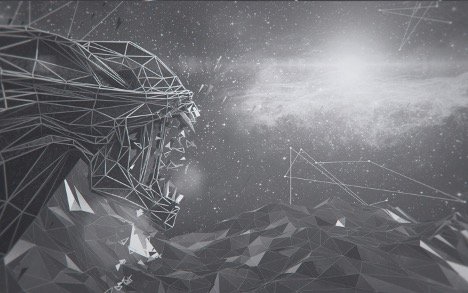
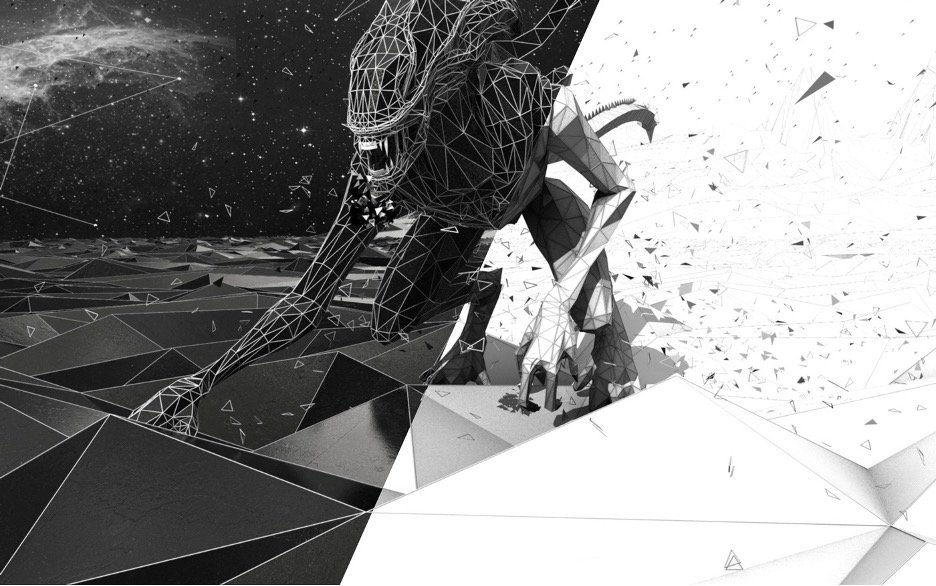
This distinction matters because most cinematic monsters are designed to perform a function inside a story. Giger’s creature appeared to have a history outside the film. Its elongated skull, skeletal body, secondary jaw and absence of visible eyes made it simultaneously biological and artificial, recognizable and fundamentally unreadable. The audience could understand that it was alive without understanding what kind of life it represented.
But Giger’s contribution to Alien extended far beyond the creature. The derelict spacecraft, the Space Jockey and the environments surrounding them followed the same biomechanical grammar. Instead of placing a monster inside conventional science-fiction scenery, Giger helped construct an ecosystem in which creature, technology and architecture seemed to belong to the same evolutionary process.
That changed the nature of the fear.
The horror came partly from losing familiar boundaries: organism and machine, interior and exterior, reproduction and destruction, attraction and disgust. The Alien did not merely threaten the human body. Its entire lifecycle violated the body’s sovereignty. Penetration, incubation and birth were transformed into mechanisms of predation. Giger made biological processes themselves hostile.
The achievement was recognized immediately. Alien won the Academy Award for Best Visual Effects in 1980, with Giger among the recipients. Yet the more consequential result cannot be measured by an award.
His visual grammar escaped the film.
Biomechanical imagery subsequently appeared throughout science fiction, horror, video games, album artwork, tattoo culture, fashion and industrial design. Countless artists absorbed fragments of Giger without reproducing him directly. Ribs became architecture. Machines became anatomical. Human bodies merged with technological structures. Darkness acquired a new vocabulary.
This is what separates an image from an architecture.
An image can become famous and remain an image. An architecture generates further images, objects, stories and interpretations after its original context disappears. Its strongest elements become sufficiently coherent that other people can enter the system and continue building from them.
Giger died in 2014. Ridley Scott continued making films. Directors, production designers, writers, game developers and artists inherited a visual territory none of them had created alone. Prometheus, Alien: Covenant and Alien: Romulus expanded, revised and reinterpreted parts of it. Games such as Alien: Isolation allowed audiences to physically navigate environments descended from the same visual grammar.
At that point authorship becomes something stranger than ownership.
The creator establishes the initial rules, but a sufficiently powerful cultural architecture eventually exceeds both the work and the person who originated it. New participants misunderstand parts of it, extend others, introduce contradictions and discover possibilities the original architect may never have intended. That does not necessarily weaken the system. It can be evidence that the system has become capable of evolution.
Nearly half a century after Alien, Giger’s creature remains instantly recognizable. More importantly, the world around it remains generative.
H. R. Giger died.
The universe did not.
It continues to live, mutate and expand without its original architect.