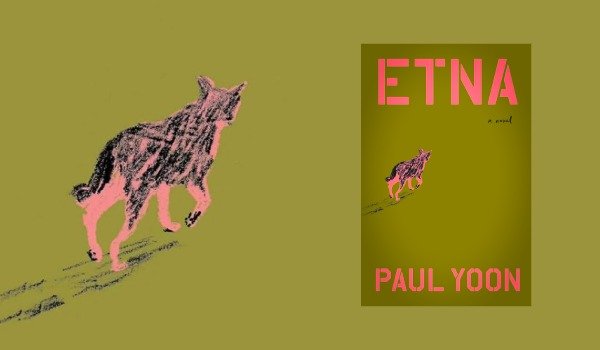
Paul Yoon has long established himself as a master of sparse, poetic restraint. His last book in 2023 The Hive and the Honey is an award-winning collection of seven short stories, first published on October 10, 2023. Goodreads has received around 1399 book votings and stands at a 3.72 total aggregate rating. Now Paul’s book, Etna, is based on a dog returning home with unbearable, cruel and horrified memories of war. The book won The Story Prize and was longlisted for the Joyce Carol Oates Prize for its elegant exploration of the Korean diaspora, tracking themes of identity, belonging, and historical trauma across centuries and continents.
In his novel Etna, he turns his stylistic focus toward an unconventional lens: an ex-military bomb-sniffing shepherd dog named Etna. Set in an unnamed, war-torn country, the novel traces Etna’s harrowing odyssey as he leaves behind the shattered soldiers he fought alongside to search for the coastal farm of his youth. Spanning just around 200 pages, the book delivers a devastatingly concise meditation on survival, displacement, and the search for home in a world fractured by violence.
Subverting the Odyssey: The Animal Perspective
Therefore, at its core, Etna acts as a contemporary, animal-eye spin on classical Homeric traditions (oral storytelling methods). Yet, rather than romanticising the journey, Yoon grounds the narrative in the immediate, sensory reality of a working dog. Reviewers have noted how the choice of an animal narrator allows Yoon to sidestep human melodrama, leaning instead into a profound, unadorned stoicism. Etna lives entirely in the present moment, reacting to unexploded ordnance, drones, and ruined landscapes with an instinctual clarity that highlights the absurdity of human conflict.
This perspective by Paul introduces a unique form of atmospheric tension in readers. As noted in critical breakdowns of Yoon’s craft, the author constructs environments through profound silence and deliberate omissions. Thus, by filtering the devastation of peacetime and war through Etna’s eyes, the novel exposes the precariousness of a world where neither humans nor animals know how to trust each other again.
Critical Reception and Thematic Resonance
Upon its release, Etna garnered widespread critical acclaim, lauded by outlets like The New York Times (deeply moving novel), TIME, and NPR as a defining literary work of the season. Critics like Maureen Corrigan have praised Yoon’s ability to evoke immense emotional resonance without falling into cheap sentimentality. She called it “profound” and “uncanny”.
- The Brutality of Peacetime: Reviewers frequently highlight how the novel brilliantly subverts expectations by showing that the end of a war does not mean the arrival of safety. Etna’s journey reveals a landscape where survival remains an ongoing daily struggle.
- Redefining Home: Much like Yoon’s previous explorations of the Korean diaspora and displacement—such as Run Me to Earth and The Hive and the Honey—Etna grapples with the painful reality that once a homeland is destroyed by history, one cannot simply go back; home must instead be radically redefined.
- The Power of Empathy: Reviewers have pointed out that despite the relentless sorrow woven into the narrative, the novel functions as an antidote to desensitisation, offering a pure, unyielding message of hope and resilience.
Paul Yoon’s Etna succeeds because it trusts the reader to fill the spaces between its sparse sentences. By viewing the fallout of human cruelty through the loyal, tracking eyes of an ex-military dog, Yoon strips away political pretence to lay bare the universal longing for a pack, a place of rest, and a fragile beginning after profound loss. It is a piercing, unforgettable addition to contemporary literature that cements Yoon’s status as a virtuoso of restraint.
This YouTube video interview provides additional context on how Paul Yoon developed the perspective of a military working dog to explore the emotional complexities of war.