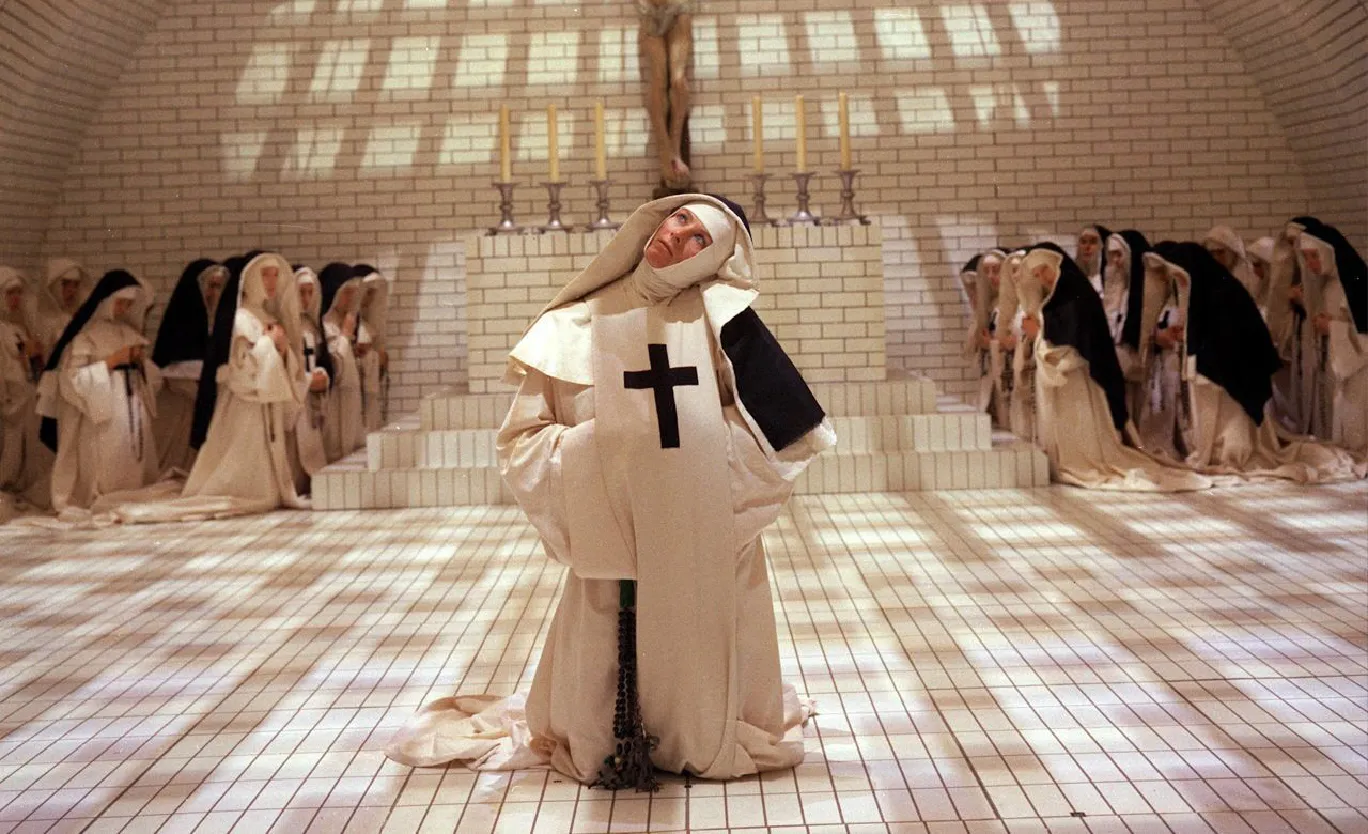
Few historical films are as confrontational, unsettling, and difficult to forget as Ken Russell’s The Devils. Released in 1971, the film remains one of cinema’s most provocative examinations of religious fanaticism, institutional corruption, and the violence that emerges when political authority disguises itself as moral righteousness.
Set in seventeenth-century France, The Devils draws on historical events surrounding Urbain Grandier, a Catholic priest whose conflict with powerful political and religious forces culminated in accusations of demonic possession, a public spectacle of religious hysteria and his execution. Russell transforms this material into something considerably more disturbing than a conventional historical drama. His film is a feverish collision of politics, sexuality, religious symbolism, and psychological terror.
The result is not a comfortable account of good people confronting evil. Instead, The Devils asks whether societies that claim to defend morality can become the very instruments of cruelty they condemn. Its religious authorities do not simply lose control of their beliefs; they exploit those beliefs to control other people. Its supposed heretics are not necessarily innocent in every respect, and its victims are not protected by the institutions that promise salvation.
The film’s enduring power comes from this unsettling contradiction. It presents a world in which the language of holiness can conceal personal ambition, collective fear can replace evidence, and the punishment of an alleged sinner can become a public performance of power.
More than five decades after its release, The Devils remains a challenging work because its central questions reach beyond the historical period it depicts. What happens when authority becomes unaccountable? How does fear transform a community? And what becomes of individual dignity when powerful institutions decide that a person’s suffering is necessary for the preservation of social order?
The Story: A Priest Trapped Between Faith and Political Ambition
At the center of The Devils is Urbain Grandier, played by Oliver Reed. Grandier is the charismatic priest of Loudun, a French town caught between religious authority and the political ambitions of Cardinal Richelieu. Grandier is a complicated figure whose confidence, sexuality and resistance to powerful interests make him an uncomfortable presence within the established order.
He is not portrayed as a perfectly innocent saint. His personal conduct complicates his public identity, allowing the film to examine the tension between religious office and human imperfection. Yet the accusations that eventually destroy him cannot be understood simply as the inevitable consequences of his private life. They emerge within a broader struggle over power, influence, and the right to determine what the public is permitted to believe.
The conflict intensifies around Sister Jeanne, played by Vanessa Redgrave, a nun whose obsession with Grandier becomes entangled with claims of demonic possession. What might initially appear to be an individual psychological crisis expands into a spectacle involving religious authorities, political interests and a community increasingly prepared to accept extraordinary accusations.
The alleged possession of the nuns becomes an opportunity for others to impose their own interpretations on events. Personal frustration acquires religious significance. Suspicion becomes supposed evidence. And the machinery of institutional authority begins to move toward a conclusion that seems increasingly predetermined.
Russell is less interested in constructing a restrained procedural investigation than in exposing the grotesque theater through which accusations acquire legitimacy. The investigation does not unfold as a neutral search for truth. It becomes a demonstration of how easily authority can transform uncertainty into conviction when the desired outcome has already been chosen.
Grandier’s predicament is therefore both personal and political. He must confront accusations that threaten his life while discovering that the institutions supposedly responsible for establishing truth may be more interested in preserving their own power.
The tragedy is not merely that a man is falsely accused. It is that an entire system can organize itself around the destruction of an individual while maintaining the appearance of moral necessity.
Oliver Reed: Charisma, Defiance and the Limits of Authority
Oliver Reed gives Grandier a commanding physical presence that makes the character difficult to reduce to a conventional martyr. He possesses the confidence of a man accustomed to attracting attention, but that confidence also places him in conflict with those who expect obedience.
Reed’s performance is crucial because Grandier’s resistance does not come from an uncomplicated purity. His personality carries contradictions, and his conduct makes him vulnerable to moral scrutiny. Yet the film insists that personal imperfection does not justify institutional persecution.
That distinction gives the story much of its moral force. A society committed to justice must be capable of distinguishing between a person’s genuine failings and accusations manufactured or exaggerated to serve a political purpose. When those distinctions disappear, punishment ceases to be a response to wrongdoing and becomes a means of controlling inconvenient individuals.
Reed plays Grandier as a man whose confidence gradually encounters a force that cannot be overcome through charisma or defiance. The qualities that initially distinguish him offer little protection once his opponents control the institutions responsible for judging him.
His predicament also challenges the traditional structure of historical martyrdom. Grandier is not presented as an immaculate figure whose virtue makes his suffering easy to interpret. His complexity makes the injustice more troubling, because the film refuses the comforting assumption that only perfect people deserve protection from cruelty.
The central question is not whether Grandier can be transformed into an ideal hero. It is whether the authorities pursuing him possess any legitimate right to turn accusation into a death sentence.
Vanessa Redgrave: The Tragedy of Sister Jeanne
Vanessa Redgrave’s performance as Sister Jeanne provides the film with one of its most psychologically disturbing dimensions.
Jeanne’s fixation on Grandier is shaped by desire, frustration, religious discipline and an environment that offers few healthy ways to understand or express complicated emotions. Her position within the convent intensifies these conflicts. She exists within a structure that regulates sexuality and personal identity while teaching its members to interpret their experiences through religious categories.
Russell does not treat Jeanne simply as a villain who invents a conspiracy. Nor does the film offer a reassuringly straightforward psychological explanation for everything she does. Instead, her character occupies an unstable space between personal suffering, obsessive desire, and the collective narratives that surround her.
Her experiences become particularly disturbing when individual emotions are absorbed into a public spectacle. Once Jeanne’s fixation becomes part of a larger narrative of demonic possession, her private life is no longer entirely her own. Other people acquire the power to interpret her actions, assign meaning to her suffering, and use her condition to advance their agendas.
Redgrave conveys the destructive consequences of this transformation. Jeanne is both an individual with her own desires and a person increasingly caught inside a system that turns those desires into evidence of something supposedly supernatural.
Her characterization raises uncomfortable questions about the relationship between repression and hysteria. What happens when people are denied ordinary language for their feelings? How easily can an institution reinterpret distress as sin, possession, or proof of an enemy’s guilt?
The film does not provide simple answers. Its disturbing suggestion is that systems of repression can produce the very crises they later claim to resolve.
Religion as Faith—and as an Instrument of Control
One of the most important distinctions in The Devils is the difference between faith itself and the institutions that claim authority over it.
The film’s target is not merely religious belief. Its deeper concern is the use of religious language to legitimize domination. The authorities involved in Grandier’s persecution present their actions through the vocabulary of spiritual duty, yet their behaviour repeatedly exposes the distance between their declared principles and their actual methods.
This contradiction is central to the film’s outrage. If an institution claims to defend truth, its judgments should be open to scrutiny. If it claims to protect the vulnerable, it should not turn suffering into entertainment. If it claims moral authority, it should be accountable for the consequences of its decisions.
In Russell’s world, however, the language of righteousness can become a shield against accountability. Accusations are accepted because they reinforce existing beliefs. Violence becomes permissible because it is framed as necessary. Cruelty acquires a public justification through the claim that it serves a higher purpose.
The resulting atmosphere is terrifying precisely because the perpetrators do not always behave as though they are committing evil. They can understand themselves as servants of order even while participating in acts of profound injustice.
This is one of the film’s most enduring insights: cruelty does not always announce itself as cruelty. It can arrive dressed in the language of duty, purity and collective protection.
The distinction also prevents the film from becoming a simplistic argument about religious people being inherently malicious. Its more troubling concern is what happens when any belief system becomes inseparable from unchecked authority. When a powerful institution controls both the accusation and the standards by which the accusation is judged, the possibility of meaningful justice begins to collapse.
Political Power Behind the Spectacle
Although religious hysteria dominates the film’s most memorable imagery, political ambition is equally important to its structure.
The conflict surrounding Grandier takes place within a France where central authority is expanding and local independence can become an obstacle to broader political objectives. Loudun is not simply a backdrop for an isolated religious scandal. It is a place where personal rivalries, institutional competition and political strategy converge.
Grandier’s position makes him vulnerable because his independence complicates the interests of those who want a more obedient social order. The accusations against him become politically useful, and the spectacle surrounding them helps conceal the calculations that make his destruction desirable.
This is where The Devils becomes more than a story about superstition. Superstition alone does not explain why certain accusations gain official support while others disappear. Political interest helps explain why a particular narrative is encouraged, why particular individuals become targets and why the machinery of punishment continues even when the supposed pursuit of truth becomes increasingly unconvincing.
The film presents power as something that must continually justify itself. When straightforward persuasion is insufficient, authority can resort to spectacle. When evidence is inadequate, it can appeal to fear. When resistance persists, it can redefine resistance as a threat to the entire community.
These mechanisms are not limited to seventeenth-century France. The specific institutions and historical circumstances have changed, but the underlying political problem remains recognizable: those who control public narratives can influence not only what people believe but also which forms of punishment they are willing to accept.
Russell’s historical setting gives these questions a particular intensity. The film’s extravagance makes the political machinery visible, exposing the absurdity and brutality of a system that treats human beings as expendable obstacles.
Sexual Repression and the Body as a Battleground
Sexuality is among the most controversial elements of The Devils, and it is inseparable from the film’s larger examination of authority.
The body becomes a site where competing claims to power are expressed. Religious discipline attempts to regulate desire, while political and institutional forces determine which expressions of sexuality are permissible and which can be condemned. The characters’ private experiences become public material that others can interpret, manipulate and punish.
Russell’s approach is deliberately confrontational. The film’s sexual imagery is not designed to preserve the distance that more conventional historical dramas maintain between the audience and their subject matter. Instead, it makes repression, desire and humiliation impossible to ignore.
Yet the extremity of the imagery can also complicate the film’s intentions. A work that seeks to expose exploitation risks reproducing some of the spectacle it criticizes. The camera’s fascination with transgression can make the viewer question whether the film is exposing the machinery of humiliation or occasionally becoming part of it.
This tension is central to any serious assessment of The Devils. Its provocative style is not automatically justified simply because its subject is disturbing. The film must be considered both for what it reveals about institutional violence and for the ways its own aesthetic choices shape the audience’s experience of that violence.
The strongest interpretation recognizes that the film’s sexual content is not an isolated attempt to shock. It belongs to a larger argument about the relationship between desire and social control. Nevertheless, the argument’s force does not eliminate the legitimate question of whether every provocation is necessary or whether some scenes risk overwhelming the human suffering they are meant to illuminate.
That ambiguity is part of what makes the film difficult to dismiss—and difficult to embrace without reservation.
Ken Russell’s Visual Style: Architecture, Ritual and Excess
Ken Russell’s direction is one of the principal reasons The Devils remains so distinctive.
Rather than pursuing historical realism through restrained performances and naturalistic environments, Russell constructs a stylized world in which architecture, colour, composition and movement intensify the story’s moral conflicts. The film’s visual design turns religious and political institutions into imposing theatrical spaces. Buildings appear to embody the systems of power operating within them, while the arrangement of bodies transforms individual suffering into a public ritual.
The result is a film that often feels closer to an operatic nightmare than a conventional period drama.
This approach is particularly effective when the story moves from private conflict to collective hysteria. The visual scale expands as the accusations acquire institutional legitimacy. Individual experiences are absorbed into carefully arranged performances, and the audience is confronted with the unsettling relationship between spectacle and authority.
Russell’s excess is deliberate. He does not want the viewer to observe the events from a comfortable distance, protected by the polished conventions of historical filmmaking. His imagery pushes toward discomfort, forcing attention onto the violence concealed within institutions that present themselves as orderly and respectable.
However, the same strategy can become exhausting. The film’s insistence on visual and emotional intensity occasionally threatens to overwhelm its characters. Some viewers will find its theatricality essential to its critique; others may experience it as excessive or alienating.
Both responses are understandable. Russell’s achievement lies less in making every moment equally effective than in creating a cinematic language that cannot be mistaken for neutral observation. The film’s style is itself an argument: power does not merely operate through laws and commands; it also operates through the images, ceremonies and spectacles that teach people how to understand authority.
The Architecture of Hysteria
The film’s portrayal of mass hysteria is among its most disturbing achievements.
Collective belief does not emerge in a vacuum. It develops through social pressure, repetition, fear and the authority granted to certain interpreters of events. Once a community accepts that a supernatural threat exists, ambiguous behaviour can be reclassified as evidence. Once an accusation becomes official, questioning it may appear to be an act of disloyalty or impiety.
This creates a self-reinforcing system. The more people participate in the spectacle, the more convincing it appears. The spectacle’s apparent legitimacy then encourages further participation.
The Devils understands that such a system can be emotionally compelling even when its factual foundations are weak. People do not always accept accusations because the evidence is persuasive. They may accept them because the accusations provide a coherent explanation for their fears, because trusted authorities endorse them, or because challenging the dominant narrative carries social and personal risks.
The film’s portrayal of possession therefore functions on several levels. It belongs to the religious worldview of the characters, but it also provides a framework through which the audience can examine the social production of certainty.
What begins as a claim about supernatural evil becomes a mechanism for identifying enemies and legitimizing punishment. The community’s desire for certainty makes it increasingly willing to overlook contradictions.
This is the frightening logic of the film: when a society becomes invested in a particular explanation, the evidence may become less important than the need to preserve the explanation itself.
Historical Drama Without the Comfort of Distance
Historical films frequently invite audiences to condemn the prejudices of the past while reassuring themselves that modern society has progressed beyond them. The Devils offers little such comfort.
Its seventeenth-century setting is essential to its story, but the film’s concerns are not confined to an unfamiliar era. Institutional self-preservation, moral panic, public humiliation and the political manipulation of belief remain intelligible to modern viewers.
The film’s historical material is dramatized rather than presented as a neutral documentary reconstruction. Its theatrical imagery, compressed conflicts and heightened characters serve an artistic argument. Viewers should therefore distinguish the film’s interpretation from a complete account of the historical events that inspired it.
That distinction does not diminish its significance. Historical drama can illuminate patterns of power without reproducing every event with documentary precision. Russell uses the past as a means of investigating recurring human tendencies: the desire to punish outsiders, the temptation to confuse obedience with virtue and the willingness to sacrifice individuals to preserve institutional authority.
The historical distance becomes a mirror rather than a barrier. The audience may initially regard the characters’ beliefs and actions as products of a distant world, only to recognize how familiar the underlying mechanisms remain.
The film’s lasting challenge is not simply to ask how people in the past could have behaved so cruelly. It asks what social conditions allow cruelty to become respectable—and whether modern institutions are as immune to those conditions as they would like to believe.
Why the Film Remains Controversial
The reputation of The Devils has always been shaped by its confrontational treatment of religion, sexuality and violence. Its release provoked controversy, and its history of censorship and restricted availability became part of its cultural identity.
Its controversy cannot be explained by a single scene or image. The film challenges several forms of cultural comfort simultaneously. It questions the moral legitimacy of powerful institutions, places sexuality at the centre of religious conflict and refuses to make historical suffering tasteful or reassuring.
For some viewers, its extremity exposes the violence that respectable language conceals. For others, the same extremity risks turning suffering into an aesthetic attraction. Both perspectives identify a genuine tension within Russell’s approach.
The film’s most serious defenders need not claim that every creative decision succeeds. Its significance lies partly in its willingness to confront material that conventional cinema often softens or avoids. Its limitations, meanwhile, invite continued debate about the ethics of representation: how can a film depict exploitation without exploiting its subjects, and how can it expose public cruelty without making cruelty itself the primary attraction?
These questions are not reasons to dismiss the film. They are reasons to engage with it critically rather than treating its reputation for transgression as proof of artistic greatness.
The Performances and the Human Cost
The scale of Russell’s visual imagination can sometimes make The Devils feel like a battle between ideas rather than a drama about individual lives. Yet the performances provide a human foundation for the film’s institutional critique.
Reed’s Grandier is compelling because he remains imperfect. Redgrave’s Jeanne is disturbing because she cannot be reduced to a simple explanation. Their characters embody different forms of vulnerability within a system that converts personal conflict into public judgment.
The supporting performances and the collective scenes reinforce the film’s sense that the tragedy is larger than any single individual. People become participants in an unfolding process whose momentum exceeds their ability—or willingness—to question it.
This collective dimension is important. Institutional cruelty rarely depends entirely on one exceptionally malicious person. It requires people who administer procedures, endorse claims, repeat accusations, participate in spectacles or decide that resistance is too dangerous.
The film’s moral universe is frightening because the destruction of a human being can become a shared undertaking. Responsibility is distributed across the system, allowing individual participants to imagine that they are merely fulfilling a role.
That is one reason Grandier’s fate remains so disturbing. His destruction is not presented simply as the consequence of one villain’s hatred. It emerges from the interaction of personal motives, political calculations, religious conviction and institutional power.
What Works—and What Does Not
The greatest strength of The Devils is its refusal to separate religious hysteria from the structures that make hysteria politically useful. The film understands that fear becomes especially dangerous when it receives institutional support and when those who question it are treated as enemies.
Its visual imagination is equally distinctive. Russell creates a world of oppressive architecture, elaborate rituals and confrontational imagery that makes power feel physical. His direction transforms the historical setting into a theatre of coercion, where public performances of righteousness conceal private and political motives.
The performances give the film much of its psychological complexity. Reed resists the simplicity of the perfect martyr, while Redgrave brings troubling emotional dimensions to a character whose suffering becomes inseparable from public spectacle.
The film’s weaknesses arise from some of the same qualities that make it distinctive. Its commitment to excess can be relentless, and its provocative imagery occasionally risks turning the subject of its critique into an object of fascination. Its characters can also become instruments of Russell’s broader argument, leaving less room for the quieter ambiguities that might have emerged through a more restrained approach.
These are meaningful reservations, not minor technical objections. A film about the exploitation of human beings must be judged partly by how it represents them. Yet The Devils remains compelling because it makes that ethical question impossible to avoid. Its style may divide audiences, but it rarely permits indifference.
Final Verdict: A Brutal, Uncompromising Examination of Power
Ken Russell’s The Devils is not an easy film, nor is it intended to be. Its vision of religious hysteria, sexual repression and political manipulation is deliberately excessive, challenging viewers to confront the violence that can hide beneath the language of morality and social order.
Its most important achievement is the connection it establishes between personal suffering and institutional power. Grandier’s fate is not simply a story about one man’s conflict with religious authorities. It is a study of what happens when the pursuit of truth is subordinated to the preservation of power, when public fear becomes a political resource and when punishment is presented as proof of moral strength.
The film’s provocative imagery and theatrical style will not work equally well for every viewer. Some will find its excess essential to its argument; others will see moments when shock threatens to overshadow insight. But its central questions remain powerful, and its willingness to expose the contradictions between professed virtue and actual cruelty gives it a significance that extends beyond its historical setting.
The Devils ultimately offers no reassuring distinction between a corrupt past and an enlightened present. Instead, it asks viewers to examine the mechanisms through which institutions manufacture certainty, turn individuals into scapegoats and convince communities that cruelty is necessary.
Its legacy rests not on controversy alone, but on its ability to make those mechanisms visible—and to leave audiences questioning the moral authority of anyone who claims that injustice becomes acceptable when committed in the name of a higher good.
Final verdict: A visually audacious, deeply unsettling and intellectually provocative historical drama. Its excess can be alienating, but its critique of institutional hypocrisy and the weaponization of belief remains formidable.