For three hours of Oppenheimer, I waited for Hiroshima. It never came. In its place came the security hearing of the man who built the bomb.
Christopher Nolan’s 2023 film is not about Hiroshima or Nagasaki. It is about J. Robert Oppenheimer, one of the fathers of the atomic bomb. I have no quarrel with that. My quarrel is with what fills the space left behind when Hiroshima stays outside the frame. I don’t know what Nolan intended. This essay is about the moral experience of one viewer, and the choices in the film that I think produced it.
I came to the film three years late. When I couldn’t get tickets for The Odyssey, I told myself I should catch up first. Plenty has been said about the editing, the sound, Cillian Murphy, the Oscars. My mind was somewhere else from the first minute.
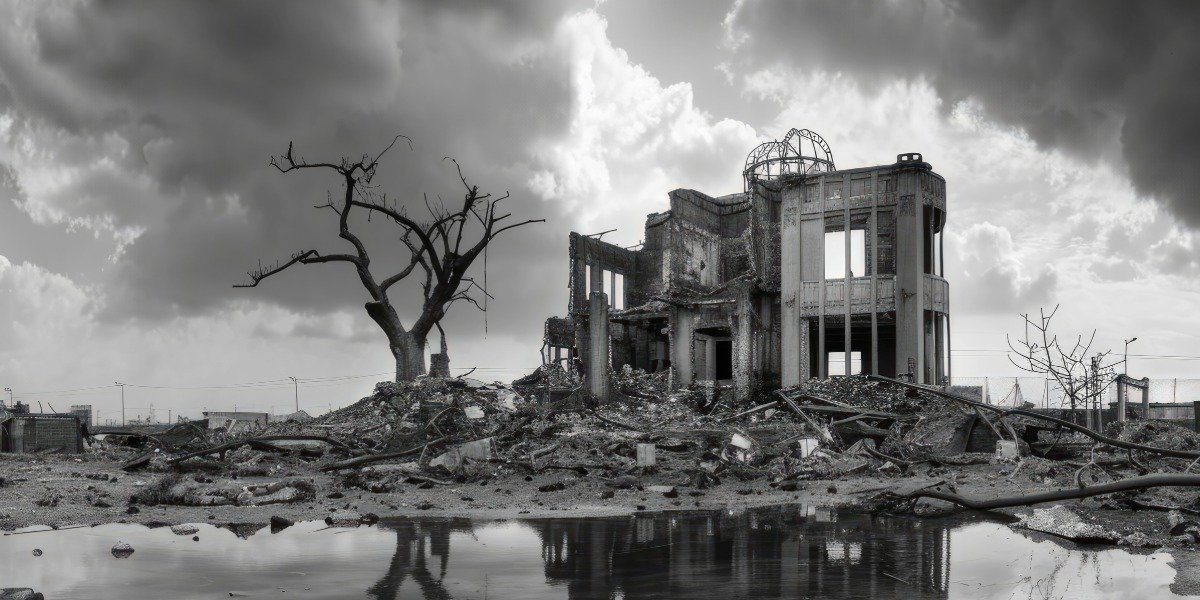
The atomic bombings killed hundreds of thousands of people. Many survivors lived with lasting injuries and illness. I wanted to see those people: the ones living with the effects of radiation, the children who grew up with leukemia, and the families aging in the shadow of an invisible poison. I waited for the camera to visit them, even briefly.
The camera didn’t turn
To be fair, it almost does, once. During Oppenheimer’s victory speech at Los Alamos, a woman’s face peels away in the crowd, and a charred body appears at his feet. But it is a hallucination. The victims exist only as the mark they leave on Oppenheimer’s mind, never as people with stories of their own.
Nolan’s defense
Let me grant the strongest counterargument up front. Nolan has defended the decision not to show the bombings through his commitment to Oppenheimer’s point of view. The film does step outside that point of view, into the black-and-white Strauss strand, yet it never steps toward Hiroshima. Its emotional closeness to Oppenheimer is a coherent artistic choice, but a choice nonetheless. The film doesn’t ignore conscience, either. Oppenheimer tells Truman he has blood on his hands, and Truman dismisses him as a crybaby as Oppenheimer leaves. Nor is Oppenheimer drawn as flawless: he is arrogant, evasive, capable of harming the people around him. The final scene adds a moral reckoning of its own. After his conversation with Einstein, Oppenheimer sees the world burning in a chain reaction.
But look at what fills that vision: a burning world. Not Hiroshima. An abstract apocalypse, with no faces, names, or homes. A subjective point of view doesn’t explain why this subject was chosen or whose face the camera stays on for three hours. Cinema doesn’t only make us think; it makes us feel. Spend three hours close to one man’s fear, loneliness, and fragility, and your empathy moves toward him. Wherever the camera lingers, conscience tends to settle.
I need to draw a distinction here. Oppenheimer may well have been treated unjustly at the hearing. But the injustice he suffered doesn’t erase the harm he caused, and the film’s emotional weight shifts toward him. You could say the film never declares him a victim. My objection is that it distributes empathy out of proportion: across three hours, we are drawn close to what happened to one man, while the lives shattered by the bomb remain largely outside the frame.
What you put in the gap
Can a story understand a perpetrator without turning him into a victim? Yes, and cinema offers examples. Jonathan Glazer’s The Zone of Interest (2023) makes a similar choice: the victims are almost never seen. But the absence is used to expose the perpetrator’s moral blindness. A family arranges its garden, its dinner table, and its children’s rooms on the far side of the Auschwitz wall, and that ordinariness, accompanied by the sounds of violence beyond the wall, carries the horror while keeping the victims largely outside the frame. Leaving something out of the frame is not the problem. What you put in the gap is. Nolan doesn’t leave the gap empty. He fills it with the political character assassination of Oppenheimer.
Cinema that centers the victims goes another way entirely. Barefoot Gen (1983), adapted from Keiji Nakazawa’s manga, follows a boy’s struggle to survive Hiroshima and the losses inflicted on his family. Shōhei Imamura’s Black Rain (1989) shows people living with radiation sickness and social stigma years after the bomb. That was what I was looking for as I watched: the long shadow the bomb cast not only over Oppenheimer’s life but over the lives of its victims.
There are also films that confront perpetrators. In Errol Morris’s The Fog of War, Robert McNamara talks at length, yet in my view he is never absolved. He acknowledges grave errors over Vietnam, yet when Morris presses him on personal responsibility and guilt, he retreats from the question. For me, those admissions never quite become a full reckoning. In Joshua Oppenheimer’s The Act of Killing (the shared surname is a coincidence), perpetrators reenact their own killings while the camera watches them inside scenes of their own making. Both films spend long stretches with perpetrators, but they stage the confrontation differently: one through interview, the other through staging and the body. I couldn’t find a comparable choice in Nolan’s film.
Two questions
The human consequences of the bomb take up very little room in the film. There are objections to using it, such as Szilard’s petition, but they receive only brief, superficial treatment. The dramatic weight rests on the security hearing, on the injustice done to Oppenheimer, and on his political isolation. So the question put to the audience becomes:
“Was this man wronged?”
The question I wanted answered was
“How did the man who built this bomb live with it, after the deaths of hundreds of thousands?”
Both questions are honest. But one asks what happened to the perpetrator, and the other asks what the perpetrator did with what he’d done.
When the film ended, I wondered whether the reckoning Nolan hadn’t shown might be found in the historical record, and I started reading about Oppenheimer’s life. He visited Japan in 1960 but did not go to Hiroshima or Nagasaki. His public remarks addressed the nuclear age and scientific responsibility.
There is also testimony of a more personal encounter. In a 2015 video recollection that came to light in 2024, the interpreter Yoko Teichler described a closed-door meeting at Princeton in 1964, where Oppenheimer, in tears, repeatedly apologized to survivors from Hiroshima. There is no record of a formal public apology, and one of the survivors present, the physicist Naomi Shono, later recalled that he had asked not to speak of Hiroshima and Nagasaki. A single recollection cannot tell us everything about that meeting, still less about his inner life. But it matters. I cannot treat the absence of a reckoning on screen as evidence that none took place outside it. The footage surfaced after the film’s release, so this is no charge against Nolan, but it sharpens my question: what room does the film’s story make for those who might have stood before him?
The same objection
I suspected I wasn’t alone in this objection. In a June 2025 interview with Deadline, James Cameron called the film a “moral cop-out,” arguing that Oppenheimer knew the bomb’s effects and the film dispatches them in one brief scene. That the same gap bothered another filmmaker meant something to me. Nolan’s answer was already on record: the film presents Oppenheimer’s experience subjectively.
The shadow at home
The question also turns my imagination toward the home: how might the consequences of a public life reach those closest to it? Oppenheimer’s daughter Toni took her own life at thirty-two. Biographical accounts describe how her father’s death weighed on her, and how in 1969 she was denied the security clearance she needed for a United Nations translator’s post, a process that revived the old charges against her father. I’m not claiming a causal link between her father’s actions and her death. I don’t know that, and I won’t pretend to. But as a screenwriter, one question stays with me, a question I may only be able to ask through fiction: how might a moral burden that a person leaves unconfronted seep into the life of their child? Perhaps I will ask it in a work of fiction I write myself.
Sources
James Cameron’s remarks on Oppenheimer (Deadline interview, June 2025)
Reported in Far Out Magazine and Fox News.
Oppenheimer’s 1964 meeting with Hiroshima survivors (Yoko Teichler’s 2015 video recollection, made public in 2024)
Jiji Press via Nippon.com; Hiroshima Peace Media.
Naomi Shono’s account that Oppenheimer asked not to discuss Hiroshima and Nagasaki
PAP (in Polish, reporting Kyodo).
Toni Oppenheimer
Atomic Heritage Foundation, “Katherine ‘Toni’ Oppenheimer” (ahf.nuclearmuseum.org); Kai Bird and Martin J. Sherwin, American Prometheus: The Triumph and Tragedy of J. Robert Oppenheimer (Knopf, 2005).