



I believe the entire world is witness to this extraordinary success. There are certain Hollywood stories that seem almost too unbelievable to be true. An aspiring actor, struggling to find meaningful work, writes a screenplay about an underdog boxer; he knows back in his mind that success is on his way to welcome him. Yes, that is true: it refuses to surrender the opportunity to play the central character and eventually turns a modest boxing drama into one of the most enduring cinematic success stories of all time. In the universe of the film industry, there is only one first person who got the tag of Rocky; he is Sylvester Stallone. Later, many movies named ‘Rocky’ were released in Bollywood, Hollywood, and so on.
Before I could step into the theater, I watched Rocky, and it was then that I realized the potential of the hard work put in by Anthony Ippolito in his movie. It sounds like the kind of inspirational screenplay Hollywood would invent. Yet the story behind Rocky is remarkably real, and I Play Rocky beautifully attempted to bring that remarkable journey to the screen; however, where does it fail? Let’s dive in.
The movie directed by Peter Farrelly, I Play Rocky, revisits the early struggles of Sylvester Stallone, exploring the determination, desperation, and creative conviction that eventually led to the creation of one of cinema’s most recognizable characters. Anthony Ippolito takes on the challenging role of Stallone, stepping into the story of a young performer who had ambition in abundance but very few opportunities to demonstrate what he could do.
At its heart, this is not simply a film about the making of a famous boxing movie. It is about the uncomfortable distance between having a dream and convincing an entire industry to believe in it.
The making of an underdog
The most interesting aspect of Stallone’s early career is not simply that he wanted to become a movie star. It is that he understood something about his own identity that the film industry could not yet recognize. Hollywood saw an inexperienced actor with an unconventional voice, limited opportunities, and a screenplay that could potentially become a profitable production. Stallone saw a character who needed to be played by someone who understood what it meant to be underestimated.
I find that distinction provides the foundation for I Play Rocky. However, you will miss important things if you do not watch Rocky before you watch I Play Rocky.
Therefore, the film takes audiences back to the early 1970s, when I did not exist on this earth, and Stallone was still struggling to establish himself. His professional circumstances are far removed from the glamorous Hollywood image that audiences would eventually associate with his name. He auditions for minor roles, encounters repeated rejection, and takes whatever work he can find to survive. His circumstances are difficult, but his ambitions remain remarkably persistent.
Peter Gamble’s screenplay builds this early period into an origin story, showing how personal frustrations, financial insecurity, and professional rejection eventually become creative inspiration. Stallone’s experiences provide the emotional vocabulary for Rocky Balboa, a fictional boxer whose greatest achievement is not necessarily winning a fight but proving that he deserves to be taken seriously.
Furthermore, the inspiration drawn from the famous Muhammad Ali versus Chuck Wepner boxing match adds another interesting dimension. Wepner’s unlikely ability to stand against one of boxing’s greatest champions offered the kind of narrative material that could become something much larger in the hands of a determined screenwriter.
However, I Play Rocky is ultimately less interested in the mechanics of screenplay writing than in the struggle to get that screenplay made.
Anthony Ippolito carries the weight of an iconic performance
Trust me, playing a young Sylvester Stallone is an unusually demanding assignment. He is not simply another Hollywood personality whose appearance can be recreated through costumes and physical resemblance. His voice, expressions, physical presence, and distinctive screen persona have become deeply embedded in popular culture.
Anthony Ippolito approaches the challenge with considerable commitment. Here you watch how much he spent to make himself look like Sylvester. Watch this official training clip from MGM Studios.
Rather than treating the role as an exercise in celebrity imitation, Ippolito attempts to capture the uncertainty of a young performer who has not yet discovered how his talents might translate into success. His performance is particularly interesting when the character moves between self-confidence and vulnerability.
And the physical transformation also deserves recognition; he is almost a carbon copy, with a well-designed costume that brought him to life back in the 70s. How much struggle is required to recreate the appearance and mannerisms of a young Stallone? It requires considerable preparation, especially when the audience already knows the person being portrayed.
What makes Ippolito’s casting especially interesting is that his own career mirrors certain elements of the story. His previous performance as a young Al Pacino in The Offer demonstrated his ability to portray an iconic Italian-American Hollywood personality. Here, he receives an even more substantial opportunity to establish himself as a leading performer.
The film’s greatest achievement may therefore be Ippolito’s performance. He gives the story an identifiable centre and provides an emotional connection to a character whose eventual success is already familiar to audiences.
Nevertheless, a biographical performance is only as effective as the dramatic material surrounding it. At times, the film appears more interested in reproducing Stallone’s recognisable characteristics than exploring the contradictions of the person behind them.
AnnaSophia Robb and the importance of believing in someone

Her character provides an important emotional counterbalance to the professional struggles unfolding around Stallone. When the industry repeatedly communicates that he is not good enough, Sasha offers a different perspective. Her belief in him becomes an important source of encouragement.
The relationship also helps the film avoid becoming an entirely one-dimensional account of professional ambition. Success is rarely achieved in isolation, and the emotional support of someone who believes in a person’s abilities can become particularly important during periods of uncertainty.
Robb brings warmth and sensitivity to the role. Her performance helps establish the personal stakes behind Stallone’s determination, even when the screenplay occasionally relies on familiar romantic-drama conventions.
The film could have explored Sasha’s own ambitions and experiences more extensively. Nevertheless, Robb contributes some of the most affecting moments.
A supporting cast that recreates Hollywood history
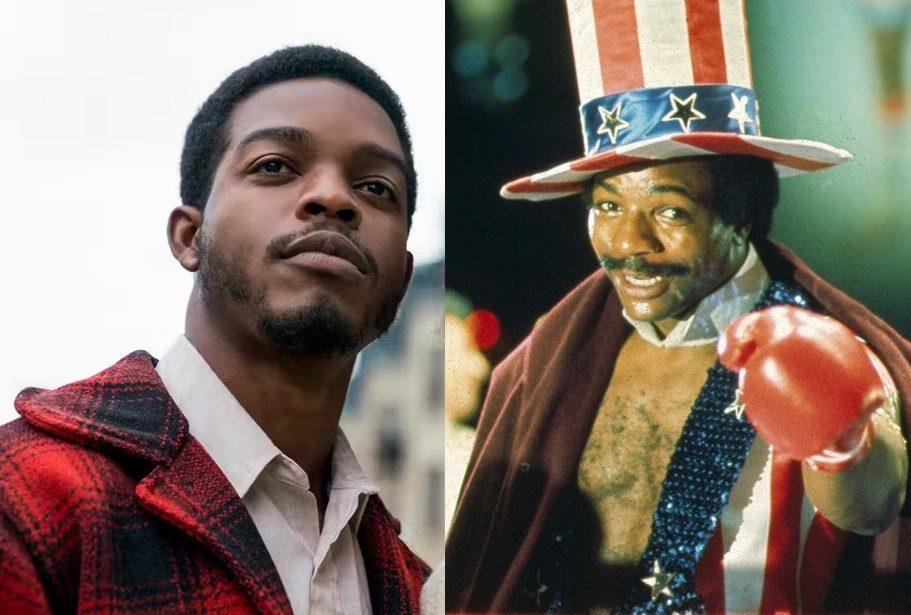
The supporting performances add considerable personality to the production.
Matt Dillon plays Frank Stallone Sr., whose difficult relationship with his son introduces another layer to the protagonist’s personal struggles. Their relationship is not presented as a conventional father-son bond built around unconditional encouragement. Instead, it reflects the insecurity and emotional complications that can accompany a family in which expectations and ambitions do not always align.
Read more: You Don’t Belong Here Movie Review
Stephan James appears as Carl Weathers, the actor who would eventually become Apollo Creed in the original Rocky. His presence provides one of the film’s most entertaining connections to the history of the franchise.
Jay Duplass portrays director John G. Avildsen, while Toby Kebbell and P.J. Byrne play producers Robert Chartoff and Irwin Winkler. Tracy Letts also appears as fictional studio executive Sandy Maddox.
Together, these performances recreate the environment in which an unlikely filmmaking opportunity gradually becomes possible.
There is something particularly enjoyable about watching the fictionalized casting process and production discussions unfold, especially for audiences familiar with the original film. The casting of Carl Weathers, the negotiations surrounding the lead role, and the determination to make a boxing drama on limited resources all provide natural dramatic opportunities.
However, the supporting characters occasionally feel more like historical markers than fully developed personalities. Their primary function is to move Stallone’s story forward rather than introduce independent emotional perspectives.
Peter Farrelly’s sentimental approach to an extraordinary Hollywood story
Peter Farrelly, whose filmmaking career includes Dumb and Dumber, There’s Something About Mary and the Oscar-winning Green Book, understands the appeal of an accessible underdog narrative.
His approach to I Play Rocky is recognisably sentimental. He places considerable emphasis on perseverance, personal relationships, and the emotional satisfaction of watching someone overcome seemingly impossible circumstances.
There is an obvious connection between Farrelly’s previous success with Green Book and his approach here. Both films take complicated real-world histories and shape them into accessible, emotionally driven cinematic experiences.
That approach has advantages. The story of Stallone’s determination to retain the lead role in Rocky is inherently entertaining. The disagreements with producers, the financial compromises, and the uncertainty surrounding the production provide a natural dramatic structure.
Yet the same approach also creates limitations.
A story about an individual who refuses to compromise should ideally contain more than a sequence of obstacles followed by predictable victories. The audience understands that Stallone eventually succeeds. What matters is discovering the psychological and emotional complexities behind his determination.
This is where the film could have been considerably more adventurous.
Instead of questioning its central character, I Play Rocky sometimes seems too protective of his legacy. Stallone is presented as an overwhelmingly sympathetic figure, and his insecurities rarely develop into meaningful personal contradictions.
The result is a film that celebrates its subject more enthusiastically than it investigates him.
Recreating Rocky: Nostalgia versus originality
One of the most fascinating elements of I Play Rocky is its relationship with the original Rocky.
For audiences who grew up watching the franchise, the opportunity to revisit the circumstances surrounding its creation is an obvious attraction. The film recreates familiar moments and draws upon the imagery associated with the 1976 classic.
The ice-rink sequence involving Rocky and Adrian is among the recognisable moments revisited by the production.
But nostalgia is a complicated cinematic tool.
Recreating a famous scene can produce an immediate emotional response, particularly when viewers already understand its significance. However, the recreation must offer something new if it is to justify its existence.
The original Rocky succeeded because its characters felt vulnerable, imperfect and human. Its emotional power came from the everyday disappointments and personal insecurities surrounding an ordinary man who wanted an extraordinary opportunity.
Simply reproducing the visual language of that film cannot automatically recreate its emotional impact.
This is perhaps the central creative problem facing I Play Rocky. It wants to celebrate the artistic achievement of Rocky, but sometimes seems more interested in reminding viewers of its most memorable moments than examining why those moments worked so effectively.
The distinction between homage and imitation becomes increasingly important as the film progresses.
What the film could have explored more deeply
The most significant missed opportunity concerns the contradictions within the original Rocky story.
Rocky Balboa was never simply a symbol of determination. The character also represented a particular vision of masculinity, ambition, class identity and the American sporting imagination.
The original film’s central boxing confrontation carries cultural and social implications that deserve more consideration, particularly through the relationship between Rocky and Apollo Creed.
I Play Rocky could have examined how Stallone’s personal experiences influenced those creative decisions and how the screenplay reflected the cultural attitudes of its time.
Instead, much of the narrative remains focused on the mechanics of getting the film produced.
Similarly, the financial desperation and professional uncertainty that shaped Stallone’s early years could have received greater psychological depth. The struggle to survive as an actor is not merely a collection of unfortunate circumstances. It can affect personal relationships, self-worth and the ability to distinguish between confidence and desperation.
These are fascinating subjects for a biographical drama.
The film occasionally touches upon them but rarely investigates them with the complexity they deserve.
Its tendency towards an uncomplicated emotional resolution ultimately makes the story less compelling than the extraordinary real-life events upon which it is based.
Technical achievements and overall presentation
At 127 minutes, I Play Rocky has sufficient room to develop its central character and establish the historical environment surrounding the production of the original film.
Sean Porter’s cinematography and Anthony Gasparro’s production design help recreate the period, while Sam Seig’s editing keeps the narrative moving between Stallone’s early struggles and the increasingly complicated process of bringing his screenplay to the screen.
Dave Palmer’s musical score supports the film’s emotional direction, although the sentimental approach occasionally feels excessive.
The production’s greatest technical challenge is recreating a familiar Hollywood history without allowing the audience’s memories of the original film to overwhelm the new story.
It succeeds in creating a recognisable period atmosphere, but its visual and musical references sometimes reinforce the impression that the production is leaning too heavily on nostalgia.
Final Verdict: An inspiring story that deserved a more ambitious film
I Play Rocky has an extraordinary real-life story at its centre. The journey of a struggling actor who refuses to surrender his screenplay or his opportunity to play its central character remains one of Hollywood’s most compelling examples of creative determination.
Anthony Ippolito gives the production a committed central performance, AnnaSophia Robb brings emotional warmth, and the supporting cast adds personality to a story populated by important figures from cinema history.
Peter Farrelly understands the emotional appeal of the material, and there are moments when his film captures the optimism and excitement that made the original Rocky such a remarkable achievement.
Unfortunately, the film’s admiration for its subject also becomes its biggest creative limitation. It frequently chooses sentiment over complexity and nostalgia over fresh interpretation. Rather than examining the complicated relationship between ambition, artistic integrity and the Hollywood establishment, it often settles for a familiar celebration of perseverance.
That does not make I Play Rocky an unsuccessful film. There is still considerable entertainment and inspiration in watching an unlikely Hollywood dream become reality.
But the irony is difficult to ignore: the original Rocky became a classic because it understood the humanity of an underdog. I Play Rocky sometimes seems so determined to celebrate that achievement that it forgets to bring the same degree of humanity to its own storytelling.
For fans of Sylvester Stallone and the Rocky franchise, this is a worthwhile cinematic history lesson. For audiences expecting a deeply revealing biographical drama, however, the result is more conventional than its subject deserves.
Ultimately, I Play Rocky reminds us why Stallone’s story matters. It just doesn’t quite deliver a film worthy of the extraordinary story it has been given.