
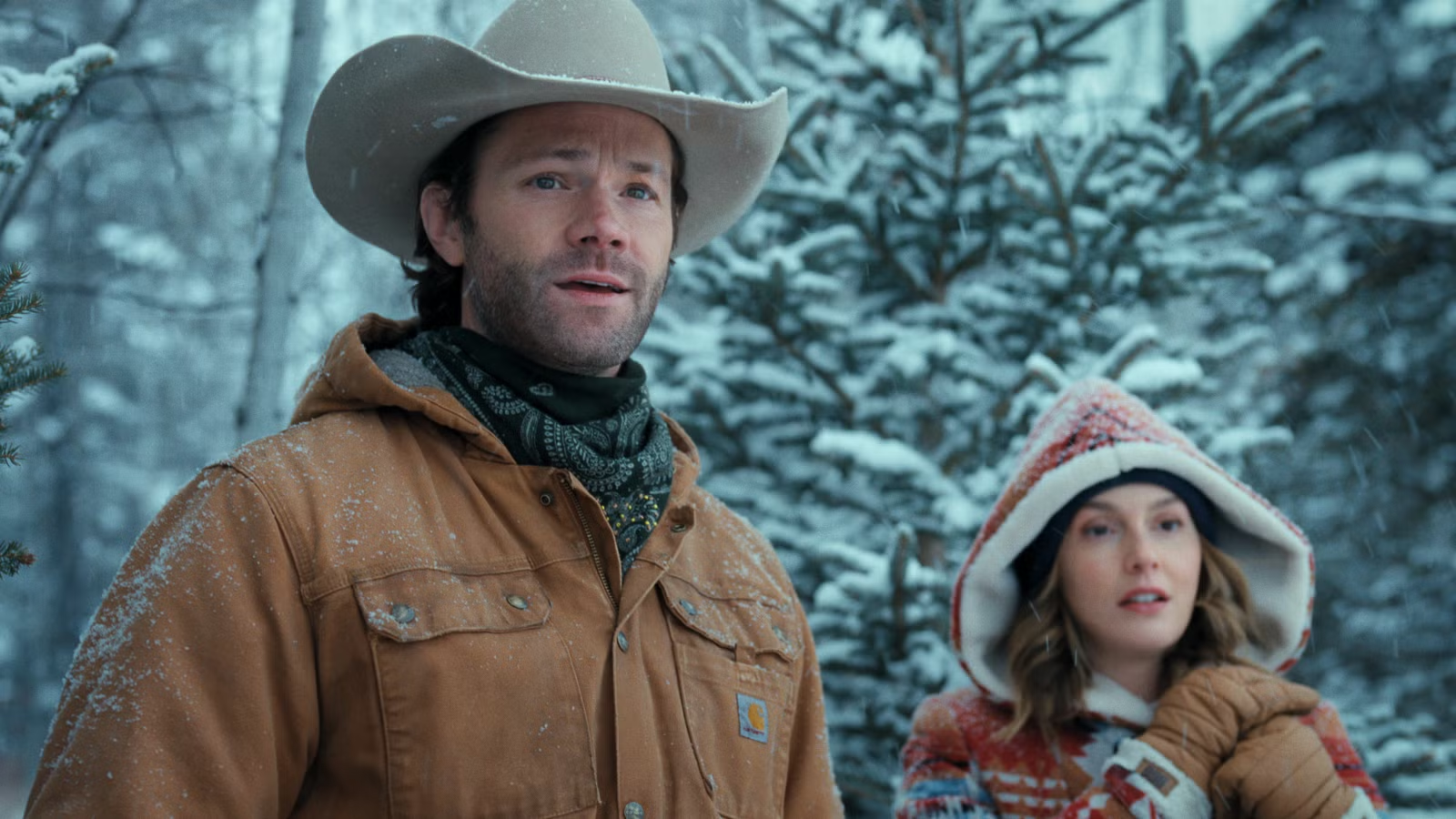


Guarding Stars arrives on Netflix with the familiar promise of a Christmas romance: attractive leads, a picturesque small-town setting, an unexpected emotional connection, and the reassuring possibility that love can emerge from the most unlikely professional circumstances. Starring Leighton Meester and Jared Padalecki, the film combines romantic comedy with a bodyguard thriller premise, attempting to find something fresh in a genre that has become increasingly comfortable repeating its own formulas.
The TV series is directed by Elizabeth Allen Rosenbaum and adapted from Katherine Center‘s novel The Bodyguard. The film follows Hannah Brooks (Meester), a highly capable private protection agent assigned to safeguard Jack Stapleton (Padalecki), a famous Hollywood actor dealing with an unwanted stalker. When Jack returns to his hometown of High Rivers, Montana, Hannah accompanies him, initially maintaining the professional distance expected of someone entrusted with another person’s safety. However, the assignment becomes complicated when personal feelings begin to interfere with professional responsibilities.
The premise offers an entertaining opportunity to explore the contrast between celebrity and ordinary life, public attention and private vulnerability, and the difference between protecting someone physically and allowing them to become emotionally close. Unfortunately, while Guarding Stars understands the appeal of these ingredients, its execution does not always demonstrate the same level of ambition.
A Familiar Romance That Finds Its Strength in Unexpected Places
The biggest challenge facing Guarding Stars is not its lack of a compelling premise but its dependence on a formula audiences have encountered countless times. The emotionally guarded professional, the charming celebrity, the accidental romantic arrangement, and the family gathering that gradually dismantles personal barriers are all familiar components of contemporary romantic comedy. The film makes little effort to disguise these conventions. Instead, it uses them as the foundation for a story that prioritizes warmth and emotional accessibility over narrative surprises.
Hannah is an interesting protagonist because her professional competence is also her emotional limitation. She understands risk, anticipates danger, and knows how to maintain control in unpredictable situations. Yet she struggles with the far more complicated business of allowing people into her personal life. Her reluctance to accept affection and her tendency to retreat into work suggest someone who has learned to survive by keeping emotional vulnerability at a distance.
The recent loss of her mother adds another dimension to this characterization. Rather than presenting grief as an isolated subplot, the film uses it to explain Hannah’s emotional withdrawal. Her professional dedication becomes a convenient mechanism for avoiding the difficult process of confronting personal loss. This is potentially the film’s most interesting psychological idea: someone who makes a living protecting others can be remarkably unwilling to acknowledge her own emotional needs.
Read more: Dexter – Resurrection Review
Let’s talk: what went well? Leighton Meester brings considerable personality to this contradiction. Moreover, her performance is arguably the film’s greatest asset. She understands that Hannah’s seriousness should not become emotional monotony, finding opportunities for dry humor, impatience, vulnerability, and understated affection. Her expressions frequently communicate more than the dialogue itself, particularly when Hannah finds herself in situations that cannot be resolved through professional discipline.
Meester also gives the character a welcome sense of independence. Hannah is not simply a woman waiting for romance to transform her circumstances. She has professional ambitions, a complicated emotional history, and a personality that exists independently of her relationship with Jack. That distinction helps the film avoid making its female protagonist entirely dependent on the romantic narrative.
However, the screenplay does not always give her characterization the complexity it deserves. Hannah’s emotional development follows a predictable progression, with familiar romantic situations repeatedly pushing her toward the same realization: that vulnerability is not necessarily weakness. The message is agreeable, but its dramatic presentation rarely feels particularly surprising.
Jared Padalecki and the Problem of the Charming Celebrity
Jack Stapleton represents the other half of the film’s romantic equation. As a successful Hollywood action star, he appears to possess everything associated with celebrity privilege: recognition, professional success, public attention, and the financial freedom to arrange his life according to his preferences.
Yet his fame has also deprived him of certain ordinary experiences. His return to Montana is motivated by a desire to reconnect with his family, particularly his mother, Connie (Andie MacDowell), who is recovering from surgery. The circumstances surrounding his family and their complicated history gradually reveal a more vulnerable individual beneath the confident public personality.
Believe or not, Jared Padalecki brings an approachable quality to Jack. His performance is relaxed, occasionally playful, and sufficiently self-aware to prevent the character from becoming an excessively polished romantic fantasy. He is particularly effective when Jack’s celebrity persona collides with the ordinary expectations of family life.
Nevertheless, Jack is not as fully developed as Hannah. His emotional struggles are understandable, but the screenplay often treats them as convenient ingredients for romantic progression rather than exploring them with genuine psychological depth.
His decision to present Hannah as his girlfriend introduces the expected fake-dating complications. The arrangement provides opportunities for humor, awkward encounters, and increasingly intimate moments. It also creates a situation in which professional boundaries become difficult to maintain.
The difficulty is that the film rarely examines the ethical implications of this arrangement with sufficient seriousness. Hannah has been hired to protect Jack, and the professional relationship should carry consequences beyond the obvious inconvenience of falling in love with a client. The narrative acknowledges the unusual circumstances but is more interested in their romantic potential than their professional complications.
The chemistry between Meester and Padalecki helps compensate for some of these shortcomings. Their contrasting personalities create an entertaining dynamic, and their interactions feel considerably more natural when the screenplay allows them to exchange observations rather than manufacture romantic misunderstandings.
The Supporting Cast Gives the Film Its Emotional Warmth
One of the more successful decisions is the emphasis on Jack’s family. The Montana ranch provides an environment in which celebrity status becomes considerably less important than personal relationships.
Andie MacDowell brings warmth and familiarity to Connie, whose illness becomes an emotional catalyst for Jack’s return home. Her character represents the importance of family connections and the painful reality that time does not always provide opportunities for reconciliation.
Shaun Johnston, as Jack’s father Doc, contributes to the film’s understated family atmosphere. Noah LaLonde’s Hank introduces another perspective on the consequences of growing up alongside a famous sibling. His character helps establish that Jack’s absence has affected more than just his relationship with his parents.
The family dynamics are not especially complicated, but they provide a necessary emotional foundation. Hannah’s gradual integration into this environment is among the film’s most enjoyable elements.
The contrast between her highly controlled professional life and the unpredictability of a family Christmas gathering generates several amusing situations. She may know how to respond to a physical threat, but dealing with family expectations, children, domestic traditions, and personal questions presents an entirely different challenge.
The supporting protection team, including Rachael Ancheril, Toby Sandeman, and Phil Brooks (professionally known as CM Punk), adds another layer of entertainment. Their presence helps maintain the connection to the security profession even when the central narrative moves toward romance.
Walker Hayes also contributes a musical element to the film through his appearance as Sheriff Sanderson, while Ava Max appears as Kennedy, Jack’s famous pop-star ex-girlfriend.
The additional casting gives the film a recognizable entertainment-industry flavor, although several supporting characters receive limited opportunities to develop beyond their immediate narrative functions.
Christmas Atmosphere Over Narrative Originality
Visually, Guarding Stars understands the appeal of its setting. The snowy Montana landscape, family ranch, festive decorations, and Christmas celebrations create an inviting environment that reinforces the film’s romantic ambitions.
Although the production was primarily filmed in Calgary, Canada, the cinematic presentation successfully establishes the atmosphere of a picturesque American holiday destination.
The setting is more than decorative. It represents an alternative to the celebrity-driven environment Jack normally inhabits and the emotionally isolated professional world Hannah has constructed for herself.
The contrast between the two environments gives the film a straightforward thematic structure. New York represents professional obligations, public attention, and constant vigilance. Montana offers family connections, familiarity, and the possibility of emotional renewal.
However, the film occasionally relies too heavily on the visual language of Christmas romance. Snowball fights, festive gatherings, cozy interiors, romantic misunderstandings, and carefully arranged moments of intimacy arrive with an almost mechanical regularity.
There is nothing inherently wrong with these conventions. Holiday romantic comedies are not necessarily expected to reinvent cinematic storytelling. Their appeal often depends on familiarity and emotional reassurance.
The problem emerges when familiarity becomes an excuse for avoiding more interesting dramatic possibilities.
The bodyguard premise initially suggests a more unusual combination of genres. A romantic comedy involving a professional protection agent could explore the psychological consequences of constant vigilance, the tension between professional responsibility and personal desire, and the complicated relationship between celebrity culture and personal safety.
Yet the security element gradually becomes secondary to the romance. The stalker threat establishes the circumstances of the assignment, but it does not develop into a particularly compelling source of sustained suspense.
Consequently, the film occasionally feels as though it is borrowing the language of an action thriller without being particularly interested in delivering one.
A Screenplay That Prefers Comfort to Complexity
Adapted from Katherine Center’s 2022 novel The Bodyguard, Guarding Stars makes changes to accommodate its Christmas setting and romantic-comedy ambitions.
Writers Erin Cardillo, Richard Keith, Gina Matthews, and Grant Scharbo build a narrative around the familiar progression of two emotionally guarded individuals gradually discovering something meaningful in one another.
The screenplay is accessible and frequently entertaining, but its predictability becomes increasingly apparent as the story progresses.
The fake relationship, family misunderstandings, romantic tension, and eventual emotional revelations follow a recognisable structure. Even when the film introduces opportunities for conflict, it tends to resolve them in ways that preserve the reassuring atmosphere.
This is particularly noticeable in the treatment of Jack’s family history and Hannah’s grief. Both subjects could have provided the foundation for a more substantial emotional drama. Instead, they largely function as stepping stones toward the film’s romantic resolution.
The film also struggles to balance its different tones. It wants to be a lighthearted Christmas comedy, a celebrity romance, a family drama, and a story about professional security. These elements are not incompatible, but they require a screenplay capable of giving each one sufficient narrative purpose.
Here, the romance consistently takes priority.
That decision is understandable, but it limits the film’s potential. The bodyguard concept deserves more attention, and the emotional consequences of Hannah’s professional choices could have been explored with greater sophistication.
Elizabeth Allen Rosenbaum keeps the proceedings moving at a comfortable pace, ensuring that the film rarely becomes emotionally exhausting or dramatically stagnant. Her direction understands the importance of performance and atmosphere in this genre.
However, a more adventurous directorial approach might have created greater tension between the film’s romantic warmth and its underlying security premise.
What Ultimately Works and What Does Not
The most appealing aspect of Guarding Stars is its central performance. Meester gives Hannah enough personality to distinguish her from the interchangeable protagonists frequently found in streaming romantic comedies. Padalecki complements her with an accessible performance that makes Jack easy to spend time with, even when the screenplay does not offer him particularly challenging material.
Their chemistry provides the film with its emotional centre.
The family environment is another strength. Connie, Doc, and the extended family help create a sense of belonging that gives the romance a purpose beyond physical attraction. The film’s treatment of grief, loneliness, and the difficulty of reconnecting with loved ones also provides moments of genuine emotional sincerity.
But its weaknesses are equally apparent.
The security premise is underdeveloped, the romantic progression is predictable, and the supporting characters occasionally feel more functional than fully realized. The film also misses opportunities to explore the tension between Hannah’s professional identity and her personal desires.
Most importantly, it rarely challenges its audience. Its emotional revelations are carefully arranged, its conflicts are relatively safe, and its conclusion follows the expectations established almost from the beginning.
That does not make it an unsuccessful film. It simply means that its ambitions are considerably more modest than its premise initially suggests.
Final Verdict
Guarding Stars is an agreeable Christmas romantic comedy that benefits enormously from Leighton Meester’s engaging performance and the comfortable chemistry she shares with Jared Padalecki. It has enough humour, emotional warmth, and festive atmosphere to make the viewing experience enjoyable, particularly for audiences who appreciate familiar holiday romances.
However, the film’s promising bodyguard premise never develops into the more substantial romantic thriller or character-driven drama it could have been. Its narrative depends on predictable situations, convenient misunderstandings, and emotional resolutions that rarely require much dramatic risk.
There is something appealing about a story in which two people who spend their lives protecting themselves eventually discover the value of letting someone else in. Unfortunately, Guarding Stars communicates this idea more effectively through its performances than through the originality of its writing.
It is a pleasant seasonal diversion rather than a memorable addition to Netflix’s original film catalogue. Those looking for a sophisticated romantic drama or an engaging thriller may find it underwhelming. Viewers seeking an uncomplicated Christmas romance, however, will likely find enough charm to justify the journey.
The stars are adequately protected; the screenplay, unfortunately, is not quite as well defended.