


A critical review of Wicker (2026), starring Olivia Colman and Alexander Skarsgård, examining its sharp satire, gender politics, selective cruelty, and frustrating finale.

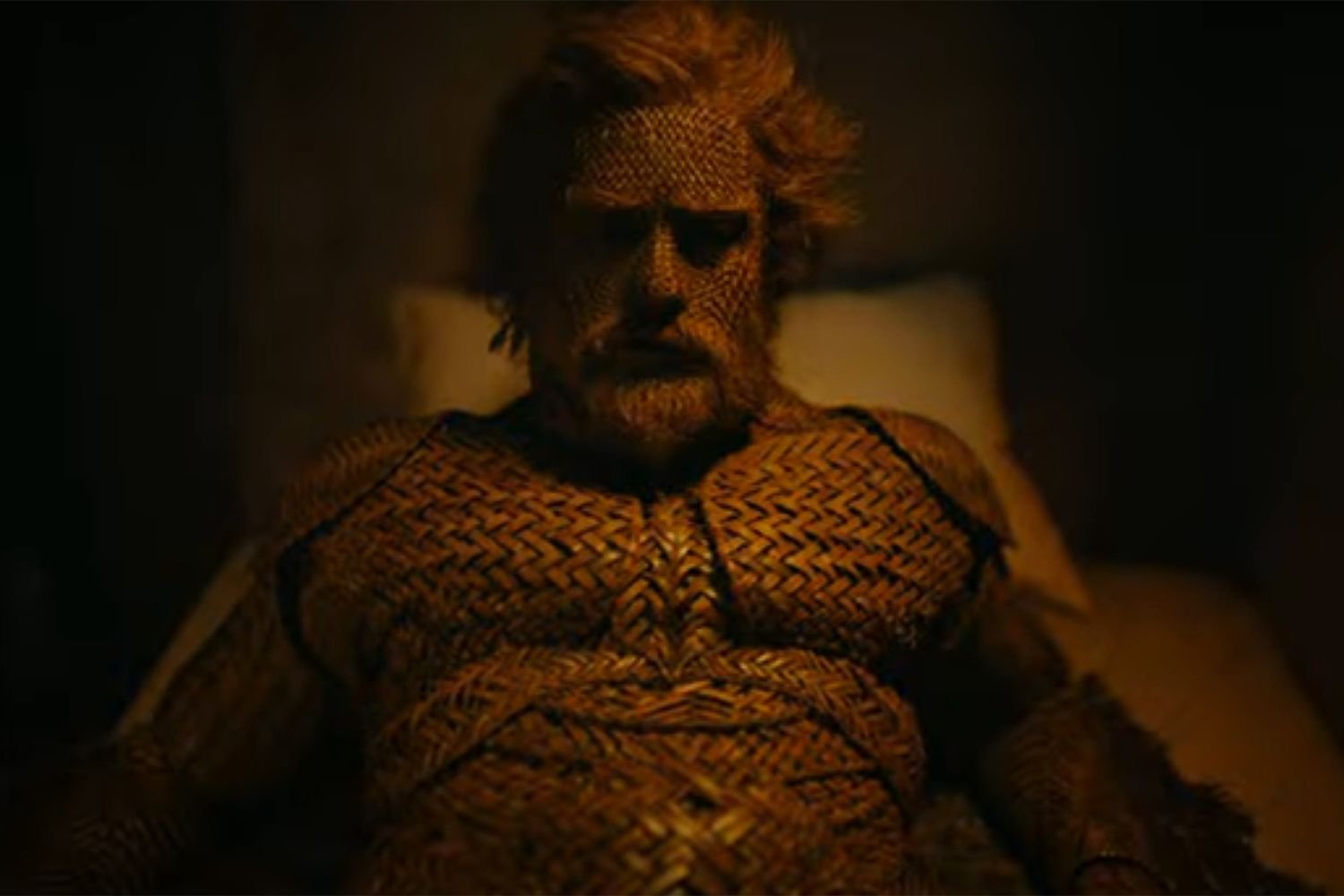
I have been thinking a lot about my reaction to Wicker, the new movie starring Olivia Colman and Alexander Skarsgård as a wicker man. I exited the theater feeling that the movie was good and that I strongly disliked it. It’s a nasty movie, which is not something I am opposed to, but where it directs its disdain left a bad taste in my mouth.
The merits of the film are clear: a wonderful and well-used cast, strong production design and art direction, excellent special effects on the Wicker man, especially for a low-budget movie, a clever and acerbic script, and a directing duo who know exactly what they want to achieve and how to achieve it. This only makes it more frustrating for me. It’s particularly unpleasant to dislike a movie whose accomplishments are so readily apparent.
Earlier that day, I’d watched my beloved Auburn Tigers get embarrassed by LSU at Jordan-Hare Stadium, so perhaps I wasn’t in the most forgiving mood. The lady a few seats away from me cackling at the film’s cheapest jokes at the expense of men didn’t help. But I’ve enjoyed plenty of movies after painful losses and alongside annoying audiences. Neither seemed sufficient to explain my reaction. If anything, her laughter made me more aware of what I found so distasteful about the movie.
Trailer
I sensed a general disdain for men and marriage, at least in this semi-medieval fairytale setting. The only decent flesh-and-blood man, in the movie’s eyes at least, is Peter Dinklage’s Basketmaker, who is almost outright identified as a homosexual man. He suggests an unsuccessful attempt at seducing the Wicker man.
What strikes me about this village is its inhabitants’ apparent comfort. The homes are spacious, the craftspeople respected, and nobody appears worried about making ends meet. It’s an apparently prosperous and functional medieval society, materially. Its inhabitants are by no means innocent. They’re happy to ridicule Fisherwoman for her smell and poke at her unmarried status. But the film is also determined to make nearly everyone outside its central characters into figures of ridicule.
There is not one couple having good sex. Not one. The movie puts that blame squarely on the men. They are all buffoons who both do not consider the feelings of the women and are simultaneously scared of them. Is the movie wrong or bad or inherently unlikeable for making all the straight men of the village emasculated schmucks? Certainly not! In fact, the main villain is a woman, Elizabeth Debicki, in an excellent turn as Tailor’s Wife. She and Fisherwoman are the only fully realized humans with skills, flaws, hopes, and dreams.
The issue is that the Wicker man is an idealized fantasy of a husband: strong, strapping, tireless, devoted, and happy to take care of household chores. A man whose existence is entirely focused on the pleasure and happiness of his wife. I understand that the Wicker man is an idealized fantasy. That’s not my issue. My issue is that the film judges the real men of the village for failing to measure up to an unattainable standard.
The Wicker man’s presence inspires jealousy and attempts at self-improvement among the men. But when they try to do better, the movie punishes them for it. The luckless Bottlewasher attempts to repair his roof, injures himself, and dies after receiving disastrously incompetent medical treatment from the village doctor, played in a delightful cameo by Richard E. Grant.
It’s an absurd sequence and could function as a nasty joke. What exactly is the joke at the Bottlewasher’s expense? He’s trying to do what the movie has been mocking him and the other men for failing to do. His reward is suffering and death. The film has little sympathy for him even when he’s trying to become the husband it supposedly wants him to be.
This gave my frustration clarity. The film directs much of its contempt toward the ordinary villagers, particularly men who are portrayed as foolish, inadequate, or incapable of understanding their partners. It wants them to improve, then sneers at them when they fail.
Yet, if this were fully a nasty movie, I think I could get over these criticisms. The third act is where it fully loses me.
Bottlewasher’s grieving wife asks Basketmaker to make her a wicker baby. He decides to do this. This choice could work if it were treated as a character flaw: a creator more interested in the act of creation than the fallout and potential consequences of that creation. It’s a selfish act not motivated by kindness but by creative ambition.
He and the film don’t consider how this grieving woman can function as a mother to this Wicker baby. The film is somewhat aware of this, as her mothering is limited to lying in bed and snuggling the crying wicker baby.
What does it mean to give this grieving woman something that looks and behaves like a baby without considering whether it’s truly a living being? Can it grow? Does it have feelings? Will it become humanish like the Wicker man?
The movie raises these questions inadvertently, then completely avoids answering them. It lets Basketmaker off the hook entirely and rewards him for his selfish behavior. In fact, he gets to lightly reprimand Fisherwoman for her extreme reaction to his second creation. The Bottlewasher dies trying to become a better husband, but Basketmaker and Fisherwoman are granted forgiveness for far more consequential actions.
The movie has set up a clever jealousy cycle between Tailor’s Wife and Fisherwoman. Colman and Debicki are extremely engaging on screen and have the best scenes. This leads to a climactic showdown where Tailor’s Wife and Bottlewasher’s Wife present the wicker baby as the product of an affair between the Wicker man and Bottlewasher’s Wife.
The accusation is absurd, but the film needs her to believe it, so she does. It works because Colman plays Fisherwoman’s insecurity so believably. Fisherwoman’s jealousy is literally set ablaze here as she attempts to murder her husband by lighting him on fire.
A few scenes and the aforementioned light reprimand from Basketmaker later, Fisherwoman, Wicker man, and Basketmaker get their fairytale ending while also exacting a nasty punishment on the town.
The movie wants to have it both ways. It wants to be a nasty old-school fable to teach a lesson but not end on a bummer note. It wants us to celebrate the found family at the end and delight at the plight of the villagers left behind.
Is this inequity and selective cruelty and forgiveness intentional and part of its fable storytelling? I think so. It’s presenting this as an outsider getting their revenge on a society that looked down on them.
The problem is the filmmakers frame it as an ending to cheer on without reckoning with what they’re asking us to celebrate: the bullied becoming the bully. A trope in media that I’ve long found tiresome and troublesome.
They almost literally ride off into the sunset, with a cart full of goodies and riches, while the villagers witness the brutal murder of the Butcher at the hands of yet another of Basketmaker’s creations.
That’s why I walked out tasting the bitter and not the sweet.