On Sept. 5, 2016, India’s internet story shifted gears. Reliance Jio entered the commercial market with a 4G network, free voice calls, and an aggressive data strategy, and what followed was much bigger than a telecom disruption. It changed the way Indians perceived mobile Internet. Data went from being something people had to be careful with to something that could run all day powering videos, music, gaming, social media, and streaming, and then the huge short-form video wave led by platforms like Instagram Reels.
Jio had no role in making Instagram Reels. Jio had entered the market four years before Instagram launched Reels in 2020. But you can’t ignore the connection between the two. Jio helped speed up an affordable, high-volume mobile data ecosystem, and smartphones, social media platforms, creators, and algorithms turned that connectivity into a new entertainment culture. In sum, Jio helped reimagine the internet highway, and Reels was one of the biggest things to travel down it.
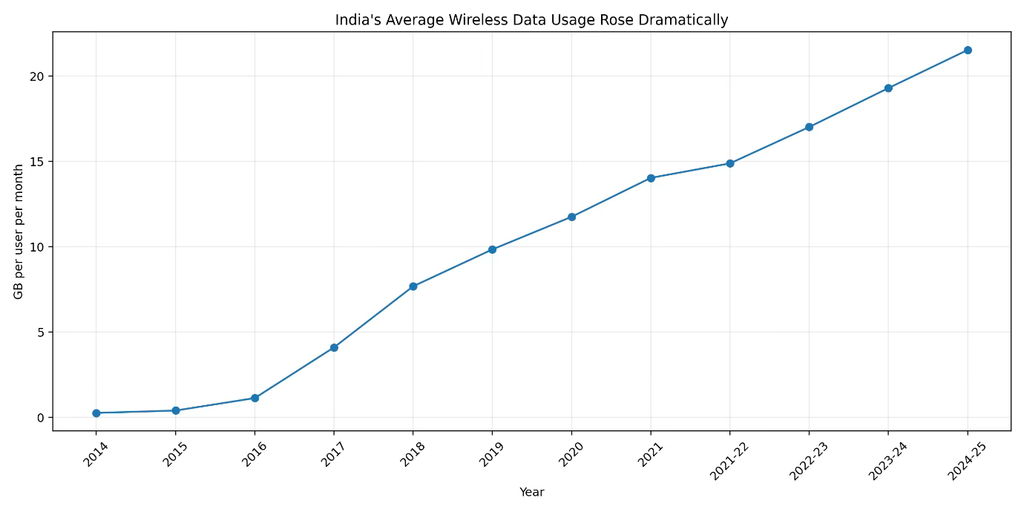
Figures tell a better story than any slogan. Average wireless data usage per active data user was 1.14 GB per month in 2016. According to TRAI, that number had increased to 21.53 GB by 2024 to 25, a nearly nineteenfold jump in under a decade.
From Saving Data to Living on the Web
Before Jio, India had a burgeoning mobile internet market. But the experience was not quite the same. Data was expensive, smartphones were less capable, and watching large amounts of video on a phone wasn’t yet a daily habit for millions of users.
Jio came with a 4G network and a strategy that placed mobile data in the heart of its offering. Reliance’s network was designed for high volumes of multimedia traffic, while users received data, voice, video, and applications in its initial Welcome Offer.
The reaction was explosive. Within just 170 days of its commercial launch, Jio crossed the 100 million subscriber base. Reliance reported more than 1 billion GB of mobile traffic being consumed every month.
But the bigger story was unfolding across the market
The competition was stiff. Prices of data changed. Plans for big data became commonplace. Consumers started watching more videos, spending more time on social media, and using apps that seemed too data-heavy before.
Average wireless data consumption per user in India rose from 1.14 GB in 2016 to 4.11 GB in 2017, 7.69 GB in 2018, 9.85 GB in 2019, and 11.76 GB in 2020. By 2024/25 it had become 21.53 GB per month.
The jump is emblematic of one of the biggest changes of the Jio decade. Indians didn’t just get greater internet access. They started using the Internet much more.
The phone slowly stopped being a communication device and became the center of digital life.
Smartphones became a new TV for desi Indians
Here’s where the connection with Reels gets interesting.
Instagram launched Reels in 2020 as a short-form video experience with a focus on music, effects, and easy creation. But by the time Reels came to India, the country’s mobile internet habits had already been transformed.
Smartphones were getting better. The price of mobile data was dropping. The consumption of video was exploding. Millions were already accustomed to spending hours online through a small screen.
The smartphone became a TV in your pocket, a camera in your hand, and, for many users, a personal media company.
A person didn’t need a TV studio to produce content. A smartphone can shoot a video, edit it, upload it, and maybe reach thousands or even millions of people.
That opened up a whole new culture of creators.
A comic could cultivate an audience without TV. A food creator may highlight local dishes. A small business could promote products with videos. A cricket fan could talk about matches from a bedroom. A small-town creator could suddenly find himself fighting for attention with someone from Mumbai or Delhi.
The pandemic gave another powerful push. As people spent more time at home, entertainment, communication, and work moved heavily to digital platforms. Short-form video found an audience already comfortable with mobile screen content.
Reels didn’t have to teach Indians how to watch videos on mobile. The habit already existed.
Reels Boom Meets a Billion-User Internet
By 2026, India’s connected audience was extraordinary in scale. TRAI recorded 1,092.79 million internet subscribers in March 2026, demonstrating the sheer size of India’s internet ecosystem.
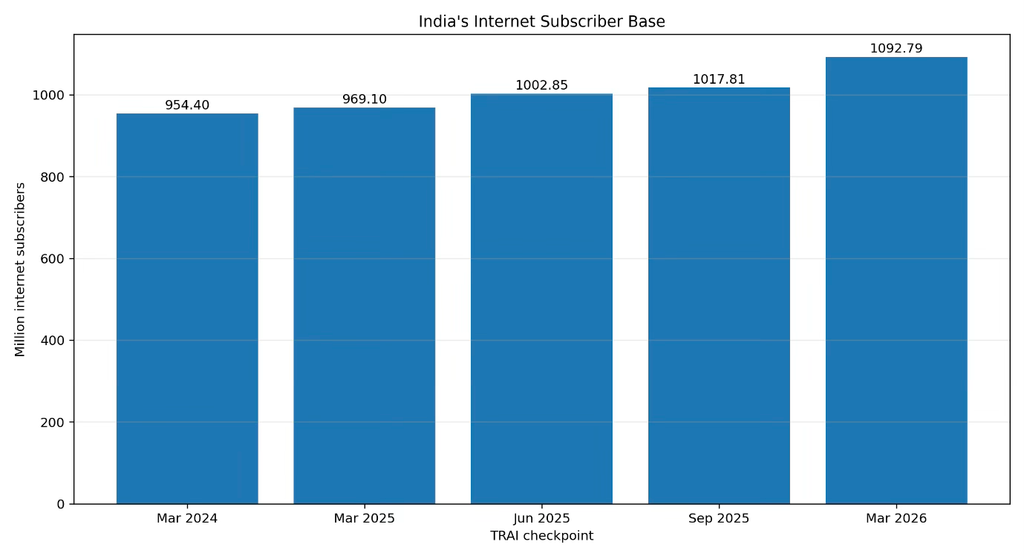
The number of subscribers is not a measure of individual persons, since one person can have multiple connections. But it does highlight the size of India’s digital market and the huge audience available to online platforms.
That audience has become especially valuable to Reels.
Meta’s 2026 research found that 97 percent of surveyed users watched videos on Meta platforms every day, and 89 percent of surveyed Gen Z users watched Reels daily. Meta also said that daily video engagement was high among both urban and rural respondents.
The findings are from a survey commissioned by Meta, not an independent measure of every Indian user, but they point to how deeply short-form video has penetrated India’s digital culture.
The creator economy has grown with it. EY pegged the Indian influencer marketing sector at ₹2,344 crore in 2024 and forecasts it to reach ₹3,375 crore by 2026.
But that growth isn’t just because of Jio. Smartphones, competing telecom networks, social platforms, creators, advertisers, and changing consumer behavior have all played a big part.
But none of this works on a large scale without connectivity.
A decade later, the Jio effect is everywhere.
In 2026, you look at India’s digital life, and you can’t miss the transformation.
Cricket is watched on people’s cell phones. They watch short videos when traveling. They find new products through the creators. They follow personas they’ve never met. Businesses promote themselves on social media now. Musicians use short videos to market their songs. Creators make careers out of bedrooms, cafes, and small towns.
Ten years ago, mobile data was something that often had to be managed.
It is now a utilitarian one.
That could be the greatest legacy of Sept. 5, 2016.
Instagram Reels was not created by Jio. It didn’t invent the creator economy, smartphones, or social media algorithms. Other telecom operators also made massive investments in their networks, and technology companies built the platforms that now rule India’s digital entertainment landscape.
But Jio helped push the market into an era where high-volume mobile data consumption became the norm.
India’s mobile internet was growing pre-2016.
And then it went supernova after 2016.
But the numbers make it impossible not to see the transformation. Average monthly wireless data usage grew from 1.14 GB in 2016 to 21.53 GB in 2024 to 25. India’s internet subscriber base crossed the billion mark, while short-form video became among the defining formats of the country’s digital culture.
And that’s why Jio’s 10-year journey is more than just about telecom.
It’s about when India began shifting from an internet people visited on and off to an internet they carried around with them.
The network was only the start. The real revolution was happening up there.
Jio changed the data game 10 years ago. That data is now powering a new India, one Reel, one stream, and one creator at a time, a decade later.