


When a Woman Becomes a Tool, Love Becomes Pity, and Storytelling Loses Its Soul
Spoiler Warning: This review discusses major plot developments.
A Woman Who Was Never Truly Searching for Freedom
Some stories fail not because they lack compelling characters, but because they lack the courage and patience to explore them.
Apple TV’s seven-part limited series Lucky, starring Anya Taylor-Joy and adapted from Marissa Stapley’s novel, is one such example. At its center stands a woman whose emotional complexity offers the foundations for an extraordinary psychological drama. Yet the series repeatedly sacrifices that potential to the familiar machinery of crime, pursuit, betrayal, and violence.
The central tragedy of Lucky is not imprisonment, nor is it the absence of freedom. For her, freedom and captivity are almost secondary concerns. What she seeks is something considerably more intimate: an embrace defined by genuine affection, dignity, and moral integrity. She wants to be loved without being used. She wants to exist without constantly having to justify her usefulness.
This is the emotional foundation upon which a remarkable series could have been built. Unfortunately, Lucky never fully constructs that foundation.
The Burden of a Soul Too Heavy for Its Own Body
Lucky’s deepest wound can be understood through a paradox: her sincerity exceeds her own capacity to endure its consequences. She resembles a soul that can no longer bear the weight of carrying its body.
Her emotional instincts reach toward something more honorable than the world in which she has been taught to survive. Yet her history, relationships, and circumstances continually pull her toward deception, danger, and moral compromise. Such a contradiction offers enormous dramatic possibilities.
A sophisticated screenplay could have explored the distance between her inner convictions and outward behavior, allowing the audience to witness the gradual formation of her emotional identity. Instead, the narrative too often replaces psychological development with another immediate crisis. Lucky runs, confronts, survives, and escapes. Yet the audience is seldom given enough time to understand how these experiences transform the person beneath the surface. Her movements are visible. Her inner evolution remains frustratingly incomplete.
The problem is not that Lucky is contradictory. Contradiction is essential to compelling characterization. The problem is that the screenplay rarely gives those contradictions sufficient dramatic space to mature.
A Father Who Gambles With His Daughter’s Life
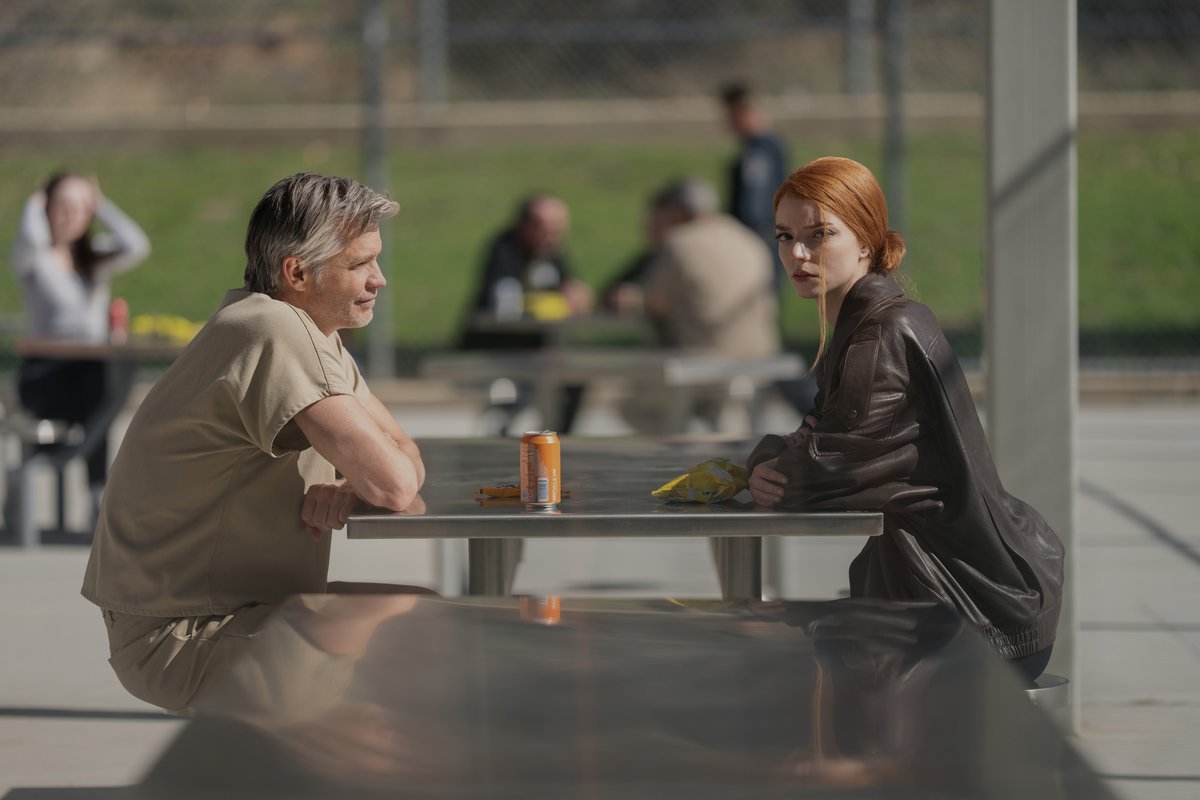
Perhaps the most disturbing social dimension of Lucky emerges through the relationship between Lucky and her father, John Armstrong, played by Timothy Olyphant. Here lies the possibility of a genuinely devastating family tragedy.
A father may repeatedly declare his love for his daughter while treating her life as something negotiable whenever money, personal advantage, or survival enters the equation. This contradiction deserves far more than the conventions of a crime thriller.
It raises an uncomfortable social question: how often does parental affection become a language used to disguise control, emotional dependency, or exploitation? A child who grows up within such a relationship may learn that love is never unconditional. Affection becomes something to be earned, negotiated, or purchased through obedience and usefulness.
Lucky’s relationship with her father can be read through precisely this disturbing possibility. She is not merely a daughter caught in a dangerous criminal environment. She is a human being whose emotional foundations have been shaped by someone who should have represented security.
The father who ought to have been her first refuge becomes part of the machinery of her insecurity. And yet the series does not examine this moral contradiction with the depth it deserves.
The material could have supported a searching exploration of inherited trauma, paternal responsibility, and the difference between loving another person and claiming ownership over their life. Instead, too much of this emotional potential is absorbed into the mechanics of the criminal plot.
When Affection Becomes Pity

Another troubling aspect of Lucky’s world is the uncertain nature of the affection surrounding her. People may care about her. Some may even believe their feelings are sincere. But caring about someone is not necessarily the same as recognizing their dignity.
There is an essential difference between love and pity. Love recognizes another person’s humanity without reducing that person to weakness, usefulness, or dependency. Pity, even when well-intentioned, can preserve an unequal relationship in which one individual remains an object of concern rather than an equal participant in affection. Lucky repeatedly appears trapped within relationships where this distinction becomes painfully relevant. She is valuable because of what she knows, what she can do, what she represents, or what others might gain through her. Her existence becomes instrumental.
And this is where the series reveals an unintended irony. The people around Lucky frequently treat her as a tool. Yet the screenplay itself sometimes commits a similar mistake, using her less as an independent psychological subject than as a mechanism for generating the next dramatic event. The woman who longs to escape exploitation becomes, in narrative terms, another instrument of the story.
The Failure of Narrative Architecture
A compelling thriller does not require constant unpredictability. It requires meaningful causality. Each event should emerge from recognizable motivations, previous choices, and the internal logic of the characters.
A successful narrative can surprise its audience while still allowing that audience to recognize, afterward, that the foundations of the surprise were present all along. Lucky too frequently struggles with this principle.
Its progression can become predictable because the characters are not consistently developed beyond their immediate narrative functions. The audience begins to anticipate not necessarily the precise details of the next event, but the familiar pattern through which the story will manufacture another obstacle.
The storyline involving FBI agent Billie Rand, portrayed by Aunjanue Ellis-Taylor, provides an instructive example. The way the series introduces personal stakes into Rand’s professional pursuit has the potential to create a meaningful conflict between duty and vulnerability.
Such material could have enriched the character and established a thematic parallel with Lucky’s own troubled family relationships. Yet, in my assessment, this development lacks sufficient preparation and integration into the broader psychological architecture of the series.
Rather than emerging as the inevitable consequence of a carefully constructed character, it risks appearing as another device introduced to intensify the plot. This is not a criticism of the idea itself. It is a criticism of its dramatic execution.
Complexity is not the same as disorder. A story becomes complex when its individual elements deepen one another. It becomes disordered when those elements merely accumulate.
Violence Cannot Replace Meaning
Crime dramas naturally depend on danger, confrontation, and sometimes extreme violence. There is nothing inherently artistically deficient about a narrative containing multiple killings, desperate escapes, or morally compromised decisions. But violence must serve a purpose beyond maintaining momentum.
It should expose character, complicate moral judgment, or produce consequences that alter the emotional trajectory of the story. Otherwise, a succession of killings, embraces, betrayals, and escapes becomes little more than a catalogue of dramatic incidents.
Cinema is not created by the number of bodies that fall or the number of people who embrace. It is created by the meaning of those actions.
What changes within a character after violence? What moral cost remains? What becomes impossible to recover? And what does the audience understand afterward that it did not understand before?
These questions should form the emotional structure of a serious psychological thriller. Too often, Lucky appears more concerned with reaching its next dramatic destination than with examining the human consequences of the journey.
The writers seem eager to travel a hundred miles of character development in a single step. But genuine emotional transformation cannot be rushed into existence. It must be earned.
Dialogue That Disappears Into the Noise
Another significant weakness lies in the absence of consistently memorable dialogue. Memorable dialogue does not necessarily require poetic language or elaborate philosophical statements. Sometimes a simple sentence, delivered at precisely the right moment, can reveal an entire lifetime of emotional suffering.
The strongest dialogue does more than communicate information. It exposes contradiction. It reveals what characters cannot admit openly. It creates silence that becomes as meaningful as speech.
In Lucky, however, dialogue frequently seems subordinate to the immediate demands of the plot. Conversations move the story forward without always deepening our understanding of the people involved.
The result is a narrative filled with activity but relatively few moments of verbal or emotional permanence. The words are spoken. The events continue. And too much of what might have remained in the audience’s memory disappears into the surrounding noise.

Anya Taylor-Joy: A Performance Beyond the Screenplay
The most important distinction in evaluating Lucky is the difference between the performance of its leading actress and the dramatic limitations of the material surrounding her.
Anya Taylor-Joy is not the weakness of this production. She is among its greatest strengths. Her portrayal carries charisma, emotional presence, and an ability to suggest vulnerability beneath an exterior shaped by survival.
She gives Lucky a recognizable human presence even when the writing does not provide the necessary depth to fully articulate that humanity. Her performance invites the audience to search for emotional meanings that the screenplay does not always develop. This is a considerable achievement.
Yet even an exceptional performer cannot independently construct the psychological architecture that the writers and directors have failed to establish. An actor can communicate fear, longing, exhaustion, and resilience. But the relationship between these emotions, the choices that produce them, and the consequences that follow must be supported by the narrative.
Taylor-Joy provides a compelling center. The series does not consistently build a world worthy of that center. The result is not the decline of an actress’s performance, but the decline of the storytelling around it.
In a stronger production, the same talent might have helped create a genuinely unforgettable portrait of a woman struggling to reclaim her humanity. Here, her performance often seems larger than the dramatic structure designed to contain it.
The Locked Courtyard of Lucky’s Inner Life
By the conclusion, Lucky has passed through a succession of dangers, betrayals, and confrontations. Yet one of the most important questions remains insufficiently explored. Has she discovered the private sanctuary of her own existence?
Every human being possesses an inner courtyard: a place where dignity, memory, vulnerability, and the longing for unconditional affection coexist. For Lucky, that courtyard seems to remain locked.
The series may resolve external conflicts, but its treatment of her inner life does not provide an equally convincing sense of emotional discovery.
An unresolved psychological journey is not necessarily a narrative failure. Some of the greatest dramatic works deliberately leave their characters wounded, uncertain, or incomplete. But an unresolved ending requires a coherent emotional journey that makes incompleteness meaningful.
Without that foundation, ambiguity risks becoming an excuse for insufficient characterization. Lucky deserved a story capable of exploring not merely whether she could survive, but whether she could finally recognize herself as something more than an instrument in other people’s lives.
Final Verdict: A Lost Opportunity for Human Drama
Lucky possesses many of the ingredients of a compelling psychological drama: a charismatic leading actress, a damaged family relationship, the corrupting influence of money, questions of moral responsibility, and a woman searching for dignity within a world that repeatedly exploits her.
Yet these ingredients never achieve the dramatic harmony they deserve. The writing and direction prioritize movement over development, incident over introspection, and immediate tension over lasting emotional meaning.
The result is a series that remains watchable largely because of the presence of its leading performer, while repeatedly revealing the limitations of its narrative construction.
The greatest failure of Lucky is not that it portrays a damaged woman. It is that the series does not fully recognize the dramatic richness of the woman it portrays.
Lucky did not need more violence to become interesting. She did not need another betrayal, another escape, or another confrontation to become human. She needed a story willing to listen to her.
She was never merely searching for freedom. She was searching for an embrace in which love would not be confused with pity, dignity would not be exchanged for money, and her existence would no longer be measured by her usefulness.
Anya Taylor-Joy understood enough of that humanity to make Lucky compelling. The screenplay and direction, unfortunately, never quite caught up with her.
And that is the real tragedy of Lucky: not a character who failed to come alive, but a story that failed to give her life the depth it deserved.
A Constructive Invitation to the Filmmakers
Criticism is not an act of destruction; it is an invitation to artistic growth. The purpose of this review is not to diminish the filmmakers’ efforts, but to encourage stronger storytelling, deeper characterization, and a more thoughtful use of the remarkable talent available to them in future productions. Lucky demonstrates how much a gifted performer can bring to a role—and how much more can be achieved when direction and writing give that talent a coherent emotional journey.